 The Dream Explainer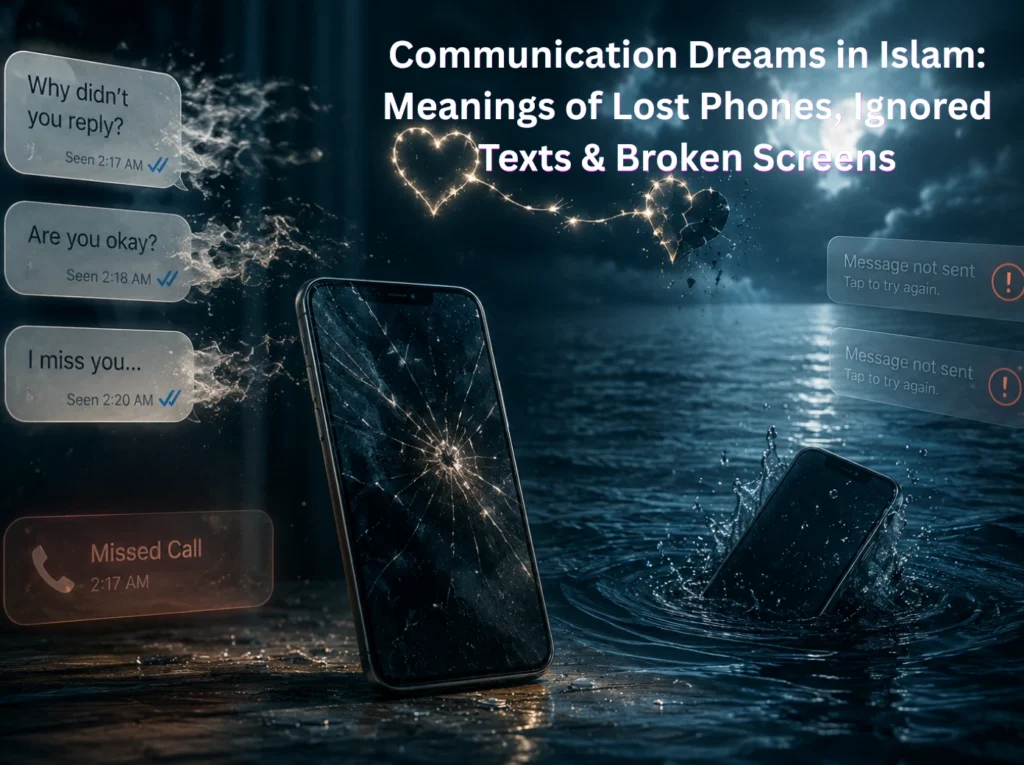
A missed call in a dream can feel deeply unsettling. Some people wake up anxious after losing a phone, staring at a broken screen, or being unable to reach someone they love. These experiences feel emotionally real long after waking.
In Islam, such dreams often reflect emotional concerns — fears of separation, unresolved tension, loneliness — rather than literal prophecy. This guide explores the most common communication dream scenarios through a calm, balanced Islamic lens. For a broader overview of how modern devices appear in dreams, see our guide to technology dreams in Islam.
Quick answer
Communication dreams in Islam typically symbolise emotional connection, distance, or misunderstanding. Dreams involving lost phones, broken screens, failed calls, ignored texts, dead batteries, or stolen phones usually reflect inner anxiety, relationship stress, or modern digital burnout rather than predictions of future events.
Islamic meaning of communication dreams
Communication carries deep emotional and spiritual weight in everyday life. Conversations allow people to reconcile, seek reassurance, maintain bonds, and express what is in the heart. When these channels break down inside a dream, the impact can feel surprisingly intense.
Classical Islamic scholars such as Ibn Sirin (author of Muntakhab al-Kalam fi Tafsir al-Ahlam) and Al-Nabulsi wrote extensively about symbols of connection and separation — letters, messengers, blocked roads, silence, and barriers. They did not discuss smartphones, but their interpretive principles apply to modern symbols through analogy.
The Quran itself establishes that true dreams can carry meaning: “For them are glad tidings in the worldly life and in the Hereafter.” (Quran 10:64) — a verse classical scholars connected to righteous dreams. The story of Prophet Yusuf (peace be upon him) in Quran 12:43–44 further demonstrates that dream symbols require careful interpretation and that not everyone possesses the knowledge to interpret them correctly.
| Modern symbol | Classical equivalent | Core meaning |
|---|---|---|
| Lost phone | Lost letter | Fear of severed connection |
| Broken screen | Torn, unreadable message | Confusion and distorted understanding |
| Unanswered call | Door that will not open | Frustration and feeling unheard |
| Dead battery | Extinguished lamp | Depletion and need for renewal |
“If one of you sees a dream he dislikes, he should spit drily to his left three times and seek refuge with Allah from its evil.”
— Prophet Muhammad ﷺ | Sahih Muslim, 2261
This guidance reminds believers to respond to distressing dreams with calm trust in Allah, not with fear or obsession.
Lost phone dream meaning in Islam
Losing a phone in a dream often symbolises a fear of losing emotional closeness with someone important. The phone represents not just communication but access — to reassurance, to relationships, to the sense of being reachable.
This dream commonly surfaces during:
- Periods of relationship uncertainty or distance
- Times of loneliness or social withdrawal
- Anxiety about being forgotten or left behind
- Stress around maintaining important connections
If the dream felt peaceful rather than distressing, the meaning may shift. Some dreamers feel relief at losing their phone — a signal that the soul is seeking rest from constant connectivity and social pressure.
Ibn Sirin noted that the emotional tone of a dream is often as meaningful as the symbols themselves. A calm lost-phone dream and a panicked one carry different messages, even if the image is identical.
Broken screen dream meaning
A cracked or shattered screen typically points to misunderstanding — something that should allow clear communication has become distorted or unreadable.
This dream tends to appear when:
- A conversation has gone badly and confusion lingers
- Someone feels they are being misread or misrepresented
- Emotional overwhelm is making it hard to process what others say
- A relationship is strained by poor communication
The broken screen does not block connection entirely — it distorts it. This is an important distinction. The dream may be nudging the dreamer toward seeking clarity rather than withdrawing.
Ignored text dream meaning in Islam
Waiting for a reply that never comes is one of the more emotionally charged communication dreams. It taps directly into fears of rejection, invisibility, and abandonment.
This dream is particularly common among people who:
- Are navigating uncertain relationships
- Tend toward social anxiety or overthinking
- Are waiting on an important response in waking life
- Have experienced emotional neglect in the past
Al-Nabulsi observed that dreams of silence or absence often reflect the dreamer’s own inner state rather than the intentions of others. The ignored text may say more about personal insecurity than about the relationship itself.
Unable to call someone in a dream
Dreams where calls repeatedly fail — no signal, a broken phone, a number that won’t connect — are among the most emotionally draining. The dreamer knows what they need to say but cannot reach the person.
This dream pattern is closely linked to:
- Grief, particularly when the person being called is deceased
- Regret over things left unsaid
- Feeling powerless in a relationship
- Unresolved conflict where the dreamer wants resolution but cannot initiate it
Islamic scholars noted that dreams of blocked paths or sealed doors often surface during periods of spiritual or emotional stagnation. Reflecting on what the dreamer wanted to say — and finding another way to express it in waking life — is often the most meaningful response. Allah reminds us in the Quran: “Allah takes the souls at the time of their death, and those that have not died during their sleep.” (Quran 39:42) — a verse that has led scholars to view sleep itself as a liminal space where the soul’s deepest concerns may surface.
Dead battery dream meaning
A dead battery removes the possibility of communication entirely, at least temporarily. Unlike a broken screen or failed call, this symbol implies exhaustion rather than conflict.
Common associations include:
- Emotional burnout from carrying too much responsibility
- Mental fatigue from overextended social obligations
- Spiritual neglect — the inner reservoir running dry
- A genuine need for rest, not just distraction
This dream rarely signals danger. More often, it is the mind’s way of communicating what the person cannot bring themselves to say: I need to stop. Spiritually, it may encourage a return to quieter practices — dhikr, prayer, time away from screens — that restore rather than stimulate. The Prophet ﷺ taught: “A good dream is from Allah and a bad dream is from Shaytan.” (Sahih Bukhari, 6984) — a reminder that when a dream feels draining rather than uplifting, it need not be dwelt upon.
Stolen phone dream interpretation
When a phone is taken by someone else in a dream, the emotional weight usually centres on violation — the sense that something private has been exposed or that a boundary has been crossed.
Their theft in a dream may reflect:
- Concern about trust being broken by someone close
- Fear of private matters becoming public
- Feeling that someone is overstepping personal boundaries
- Vulnerability in a relationship where power feels unequal
This dream does not predict betrayal. In most cases, it is an expression of emotional sensitivity rather than a warning about a specific person. Ibn Sirin counselled against acting on suspicious dreams without clear waking-life evidence. If dreams about exposure and violated boundaries recur, our guide to privacy and security dreams in Islam explores this theme in greater depth.
Phone exploding dream meaning
An exploding phone is perhaps the most dramatic of communication dreams. It suggests something has been building — pressure, tension, unexpressed emotion — and reached a breaking point.
This image commonly appears when someone is:
- Managing conflict while suppressing their true feelings
- Overwhelmed by constant demands for their attention
- Experiencing a breakdown in an important relationship
- Burnt out by the relentless pace of digital life
The explosion is rarely a warning of literal danger. It is the dream’s way of dramatising what the dreamer may already know: something needs to be addressed, not just endured.
Emotional and spiritual meanings behind communication dreams
Relationship anxiety
The most common driver of communication dreams is relational fear — the anxiety that a bond is weakening or that a person who matters has emotionally withdrawn. These dreams tend to intensify during periods of change, distance, or unresolved conflict.
Feeling unheard
Recurring dreams about ignored messages or failed calls often point to a deeper pattern: the feeling that one’s voice does not register. This is not always about a single relationship. Sometimes it reflects a broader sense of invisibility that has gone unexamined.
Spiritual disconnection
Dreams of weak signals or drained batteries occasionally carry spiritual resonance — a gentle indication that the dreamer’s inner life has been neglected. This is not punishment or divine warning; Islamic tradition consistently distinguishes between prophetic dreams and ordinary ones shaped by daily experience. But the image may still prompt useful reflection.
Digital burnout
Modern life makes communication inescapable. Notifications, expectations of instant replies, and the pressure to be perpetually reachable can saturate the mind. Many communication dreams are simply the brain processing this overload — a pattern explored in depth in our article on digital anxiety dreams in Islam. Reducing screen time in the hour before sleep has been shown to reduce stress-driven dream intensity.
Islamic dream interpretation framework
Emotional context matters
Ibn Sirin emphasised that the same symbol can carry opposing meanings depending on the emotional climate of the dream. Fear and calm are themselves part of the interpretation.
Avoid fear-based or accusatory readings
A distressing dream should not be used as evidence against another person or as a basis for suspicion. Islam strongly discourages paranoia and unfounded accusation. The Prophet ﷺ said: “The good dream of a righteous man is one of forty-six parts of prophethood.” (Sahih Bukhari, 6983) — ordinary stress-driven dreams carry no such weight and should not be used to judge others.
Analogy with classical symbols
Since classical scholars wrote about messengers, letters, roads, doors, and silence, modern dreamers can interpret digital communication through these same frames. The technology is new; the human fears it represents are ancient.
Psychological dimension
Many communication dreams arise not from spiritual significance but from ordinary anxiety, loneliness, or overthinking. This is not a lesser explanation — it is an honest one, and addressing the underlying emotional state is a legitimate and practical response. For a full overview of how Islam approaches dream interpretation, see our guide to Islamic dream interpretation.
What to do after seeing communication dreams
-
Stay calm
Most communication dreams reflect current emotional states, not future events. Waking up anxious from a dream does not mean the anxiety is warranted. For practical steps grounded in Islamic guidance, read our full article on what to do after a bad dream in Islam. -
Reflect honestly
Is there a relationship that needs attention? A conversation that has been avoided? A person who deserves a message? -
Address the emotional cause
If loneliness, insecurity, or relational tension is driving these dreams, the most meaningful response is to address those realities in waking life. -
Strengthen spiritual routine
Regular dhikr, dua, Quran recitation, and reduced screen time before sleep support both emotional regulation and restful nights. -
Recite the morning and evening adhkar
The Prophet ﷺ recommended seeking Allah’s protection upon waking from a disturbing dream (Sahih Muslim, 2261).
Frequently asked questions
What does a lost phone dream mean in Islam?
A lost phone dream typically symbolises fear of emotional disconnection or anxiety about losing closeness with someone important. If the dream felt peaceful, it may instead reflect a genuine need for rest from social pressure and constant connectivity.
What does a broken screen dream mean spiritually?
A broken screen often represents misunderstanding, emotional confusion, or distorted communication. It may appear when conversations in waking life feel unclear, frustrating, or unresolved — and may be a prompt to seek clarity rather than distance.
Why do I keep dreaming about ignored messages?
Recurring dreams about messages going unanswered usually point to emotional insecurity, fear of rejection, or a pattern of feeling overlooked. Al-Nabulsi observed that such dreams reflect the dreamer’s inner state more reliably than the intentions of others.
Is a stolen phone dream a warning in Islam?
Not typically. Stolen phone dreams most often express feelings of vulnerability or a fear that personal boundaries are being crossed. Ibn Sirin counselled against acting on suspicious dreams without clear waking-life evidence — they should not be used as grounds for accusation.
Can these dreams come from stress or anxiety?
Yes. Emotional exhaustion, relationship tension, loneliness, and digital overload are all common contributors to communication-themed dreams. Addressing these root causes is often the most practical and meaningful response.
Are communication dreams messages from Allah?
Classical Islamic scholarship distinguishes between three types of dreams: true dreams (from Allah), the whisperings of the self, and disturbances from Shaytan (Sahih Muslim, 2263). Most ordinary dreams — including stress-based communication dreams — fall into the second category and reflect personal emotional experience rather than divine communication.
Communication dreams in Islam speak to something universal: the human need to feel heard, connected, and close to those we love. When these needs go unmet — or when we fear they might — the mind processes that vulnerability during sleep.
The healthiest response is not fear but honest reflection. A dream may illuminate emotional tension without predicting the future. Islam encourages patience, honest communication, emotional balance, and complete trust in Allah.
Allah knows best.