 The Dream Explainer
Quick Answer
What should you do after a bad dream in Islam? Seek refuge with Allah from Shayṭān and from the evil of what you saw. Spit lightly to your left three times, turn onto your other sleeping side, and avoid spreading the disliked dream.
If you remain troubled, you may get up and pray. These actions are based on authentic Sunnah guidance, including Sahih Muslim 2261d, 2262, and 2263a.
A frightening nightmare does not automatically predict future harm or prove jinn, siḥr, or possession. Seek Allah’s protection rather than dwelling on fear. Allah knows best.
If you are wondering what to do after a bad dream in Islam, begin by seeking refuge with Allah and following the simple Sunnah steps below. A nightmare can feel frightening, but it is not proof that something terrible will happen.
Islam offers a practical response that centres on seeking Allah’s protection, changing your sleeping position, and avoiding unnecessary discussion of the nightmare.
These instructions are more important than searching for frightening predictions or assigning a meaning to every detail of a disliked dream.
How Should a Muslim Respond to a Bad Dream?
The Prophet Muhammad ﷺ taught believers how to respond after a dream they dislike. The guidance directs attention toward Allah’s protection rather than fear of the dream itself.
In Sahih Muslim 2263a, distressing dreams are discussed alongside good dreams and dreams arising from a person’s own thoughts.
For someone who has awakened from a frightening nightmare, the immediate concern is what to do next, not determining a certain symbolic interpretation.
Important reassurance
A bad dream is not reliable evidence that illness, death, betrayal, loss, or supernatural harm is approaching. Follow the Sunnah without treating the nightmare as a prediction.
What counts as a disliked dream?
A disliked dream may involve a frightening event, threatening person, disturbing imagery, or another experience that leaves you upset after waking.
Not every unpleasant dream has the same origin. Some dream imagery may also reflect worries, memories, or stressful experiences.
What to Do After a Bad Dream in Islam: Five Sunnah Steps
The authentic narrations describe several simple actions after a disliked dream. These can be followed without complicated rituals.
What to do immediately
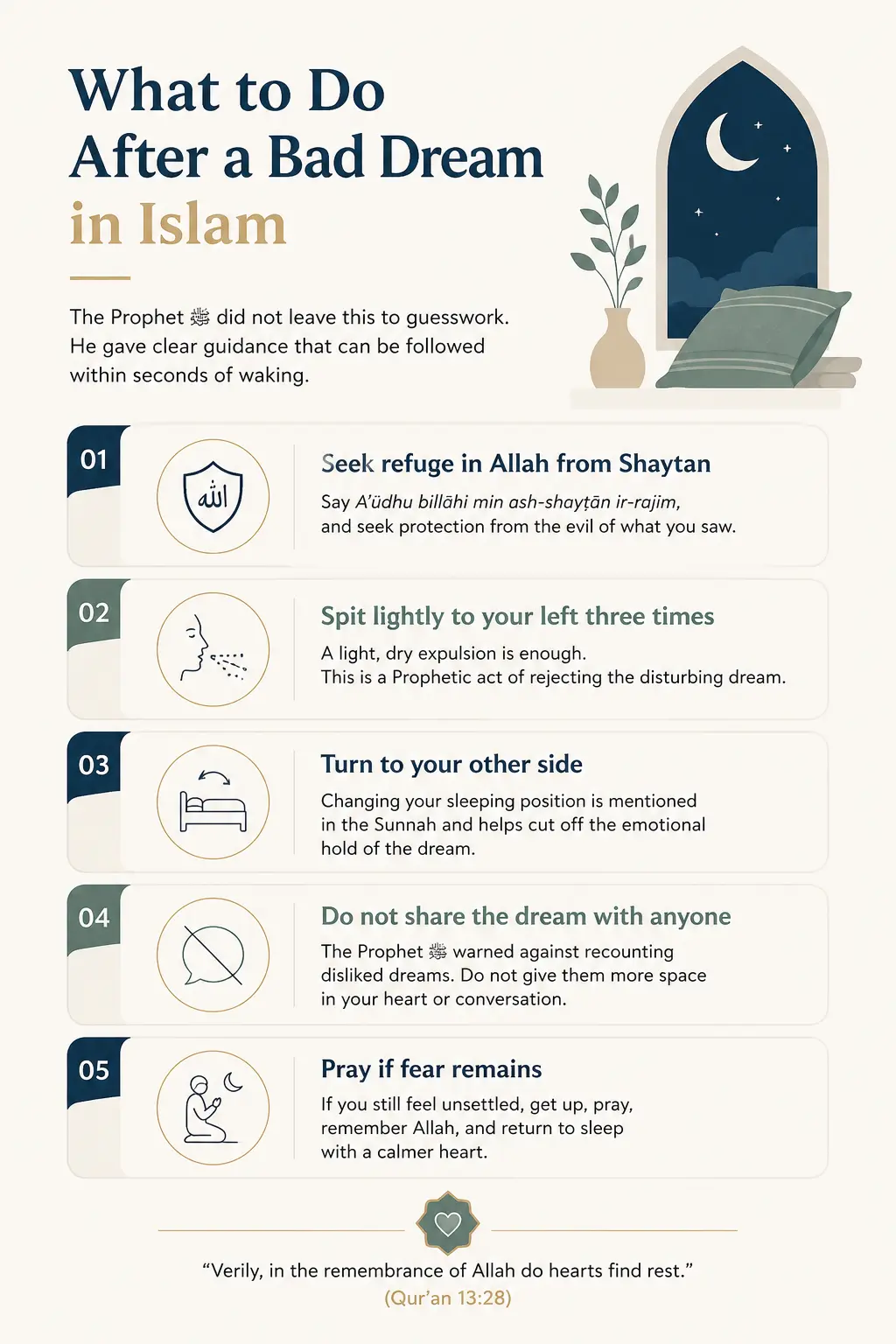
- Seek refuge with Allah. Ask Allah to protect you from Shayṭān and the evil of what you saw.
- Spit lightly to the left three times. This is a gentle action, not forceful spitting.
- Turn onto your other sleeping side. Change the side on which you were lying.
- Do not spread the disliked dream. Avoid retelling it unnecessarily or inviting alarming speculation.
- Pray if you remain unsettled. Getting up to offer prayer is mentioned in an authentic narration.
The instructions appear across Sahih Muslim 2261d, Sahih Muslim 2262, and Sahih Muslim 2263a.
Which side should you spit on after a nightmare?
The authentic instruction is to spit lightly toward the left side three times.
The practice is mentioned alongside seeking refuge with Allah. Another narration also instructs changing the side on which the person was sleeping.
Should you go back to sleep?
You may return to sleep after following the Sunnah guidance. If you remain unsettled, you may get up and pray.
You do not need to stay awake because you fear the nightmare will otherwise come true.
What if you forgot the Sunnah steps?
If you remember afterward, seek Allah’s protection without panicking or repeatedly checking whether every action was completed perfectly.
Forgetting one of the steps is not evidence that the dream will cause harm.
Du‘ā After a Bad Dream in Islam
When looking for a du‘ā after a bad dream or nightmare, the main authenticated guidance is to seek refuge with Allah from Shayṭān and the evil of the dream.
You may use the familiar phrase of seeking refuge:
Seeking Allah’s protection
أَعُوذُ بِاللَّهِ مِنَ الشَّيْطَانِ الرَّجِيمِ
A‘ūdhu billāhi min ash-Shayṭān ir-rajīm.
Meaning: I seek refuge with Allah from Satan, the rejected.
This is a general phrase of seeking refuge, not an exclusive formula for nightmares. The Sunnah also directs believers to seek protection from the evil of what they saw.
Can you make du‘ā in English?
You may ask Allah for protection and reassurance in your own words. For example:
O Allah, protect me from Shayṭān and from the evil of what I saw. Grant me peace and safety.
This is an example of personal supplication, not a claim that these exact English words form a separately narrated Prophetic du‘ā.
Is there a du‘ā to stop a nightmare from coming true?
The authentic response is to seek refuge with Allah and follow the Sunnah guidance for disliked dreams.
There is no need to invent a special formula, count additional repetitions, or assume that the nightmare contains a prediction requiring intervention.
Authentic Hadith About Bad Dreams and Nightmares
Several authentic narrations provide complementary instructions for responding to a disliked dream.
| Hadith reference | Guidance |
|---|---|
| Sahih Muslim 2261d | Seeking Allah’s protection and spitting lightly toward the left three times. |
| Sahih Muslim 2262 | Seeking refuge, spitting to the left, and changing sleeping sides. |
| Sahih Muslim 2263a | Different categories of dreams, offering prayer, and not relating a disliked dream. |
| Sahih al-Bukhari 6986 | Seeking refuge after a disliked dream. |
Does a disliked dream harm the person?
The authentic narrations include reassurance concerning the disliked dream when the believer follows the prescribed guidance.
This reassurance encourages trust in Allah. It should not be misunderstood as permission to ignore genuine waking-life medical or safety concerns.
Can a Bad Dream Come True in Islam?
A frightening nightmare is not reliable evidence of a future event. It does not establish that death, illness, divorce, betrayal, or another feared outcome is approaching.
The Sunnah encourages seeking Allah’s protection rather than pursuing frightening predictions about a disliked dream.
Are bad dreams warnings from Allah?
Not every frightening dream should be described as a warning from Allah. The authentic framework includes distressing dreams and dreams arising from matters already occupying the mind.
A dream alone cannot establish certainty about events that have not happened.
What if the dream involved death or an accident?
A nightmare involving death, injury, or an accident may feel particularly unsettling, but the imagery does not confirm that the event will occur.
Respond according to the Sunnah and judge waking-life concerns through reliable evidence.
Do not make fear-based decisions
Do not cancel important plans, accuse someone, stop medical treatment, or make major financial decisions because of a nightmare alone.
Should You Tell Someone About a Bad Dream?
The Prophetic guidance is not to spread a disliked dream among people.
Repeatedly retelling frightening details may also encourage unnecessary speculation and prolong distress.
Should you ask someone to interpret a nightmare?
A disliked dream generally does not need detailed symbolic interpretation. The immediate religious guidance is to seek Allah’s protection and avoid dwelling on the frightening experience.
For broader questions about dream meanings and the principles of interpreting non-frightening dreams, see our Islamic dream interpretation guide. This article focuses specifically on what to do after a bad dream.
What if you need help after a frightening dream?
If repeated nightmares cause significant anxiety or disrupt sleep, speaking with a trusted person or healthcare professional about the distress is different from spreading a nightmare for speculative interpretation.
Seeking appropriate help does not mean treating the dream as a prediction.
Recurring Bad Dreams and Nightmares
Occasional nightmares are common, but repeated frightening dreams may affect sleep quality, concentration, mood, or the willingness to go to bed.
Psychological meaning of recurring nightmares
From a psychological perspective, nightmares may be influenced by stress, grief, trauma, anxiety, disrupted sleep, illness, or certain medications. Repetition may relate to ongoing concerns or sleep difficulties, but it does not establish a medical diagnosis, a supernatural cause, or a prediction about future events.
What if you keep having nightmares about jinn?
Dreams involving frightening figures or unseen presences do not prove jinn involvement or spiritual attack.
For a discussion of that particular imagery, see our seeing jinn in a dream in Islam guide.
What if someone appears possessed in your nightmare?
Seeing a loved one behaving as though possessed does not prove they are spiritually harmed.
Read our guide to seeing someone possessed in a dream in Islam for this specific scenario.
Could the experience be sleep paralysis?
If you became aware while temporarily unable to move or speak, particularly around waking, you may have experienced sleep paralysis rather than an ordinary nightmare.
See our sleep paralysis in Islam guide for the distinction.
When should you seek medical help?
Consider professional advice when nightmares repeatedly affect sleep or daily functioning, cause fear of going to bed, or are connected to distressing experiences.
The NHS guide to nightmares and night terrors explains these differences and when to seek medical support.
Sunnah Protection Before Sleeping
Authentic bedtime recitations and remembrance can form part of a calm routine after an upsetting night.
These practices are established acts of worship, not guaranteed medical treatments for nightmare disorders.
Bedtime checklist
- Perform wuḍū’ when practical.
- Begin sleeping on your right side.
- Recite Āyat al-Kursī.
- Recite Sūrat al-Ikhlāṣ, al-Falaq, and al-Nās.
- Maintain authentic bedtime adhkār.
- Keep regular sleep and waking times when possible.
- Reduce frightening content and other sleep disruptions before bed.
Āyat al-Kursī before sleep
Authentic hadith discusses reciting Āyat al-Kursī before sleeping. See Sahih al-Bukhari 3275 and Qur’an 2:255.
The three protective sūrahs
Sahih al-Bukhari 5017 describes reciting al-Ikhlāṣ, al-Falaq, and al-Nās, blowing into the hands, and wiping the body before sleeping.
Wuḍū’ and sleeping on the right side
Sahih al-Bukhari 247 includes guidance about making wuḍū’ and beginning sleep on the right side.
For a more complete routine, see our du‘ā before sleeping in Islam guide.
Frequently Asked Questions
What should I do immediately after a bad dream in Islam?
Seek refuge with Allah, spit lightly to the left three times, turn onto your other side, and avoid telling people about the disliked dream. You may pray if distressed.
What du‘ā should I read after a nightmare?
Seek refuge with Allah from Shayṭān and the evil of what you saw. A‘ūdhu billāhi min ash-Shayṭān ir-rajīm is a familiar general phrase of seeking refuge.
Which side should I spit on after a bad dream?
The authentic narrations mention lightly spitting toward the left three times.
Can a bad dream come true in Islam?
A nightmare is not reliable evidence of a future event. Follow the Sunnah response instead of treating it as a certain prediction.
Should I tell someone about a bad dream?
The Sunnah discourages spreading disliked dreams. If recurring nightmares affect your wellbeing, seeking appropriate support for sleep-related distress is reasonable.
Should I pray after a nightmare?
You may get up and pray after a disliked dream, as mentioned in Sahih Muslim 2263a.
Do I need ghusl after a bad dream?
A frightening dream alone does not require ghusl. Different rules apply to a wet dream when discharge requiring ghusl is found after waking.
What if I forgot the Sunnah steps?
Seek Allah’s protection when you remember and avoid unnecessary worry. Forgetting a step does not establish that the nightmare will cause harm.
Why do I keep having bad dreams?
Recurring nightmares may be associated with stress, trauma, illness, medication, or disrupted sleep. Seek professional advice if they repeatedly affect your wellbeing.
Final Reflection
Islam offers a clear and reassuring response to bad dreams. Seek Allah’s protection, follow the Sunnah guidance, and avoid turning a frightening nightmare into a prediction.
If recurring nightmares interfere with sleep or daily life, spiritual remembrance can be combined with appropriate medical support.
Allah knows best.
Authentic Islamic and Health Sources
- Sahih Muslim 2261d — seeking refuge and spitting lightly to the left after a disliked dream.
- Sahih Muslim 2262 — changing the sleeping side.
- Sahih Muslim 2263a — categories of dreams, prayer, and not relating disliked dreams.
- Sahih al-Bukhari 6986 — guidance after a disliked dream.
- Sahih al-Bukhari 3275 — Āyat al-Kursī before sleep.
- Sahih al-Bukhari 5017 — protective sūrahs before sleep.
- Sahih al-Bukhari 247 — wuḍū’ and sleeping on the right side.
- NHS — nightmares, night terrors, and when to seek medical advice.
Editorial note: This article provides Islamic educational guidance, not a fatwa, medical diagnosis, or prediction. Follow authentic religious guidance and seek appropriate healthcare advice for persistent sleep problems.