 The Dream Explainer
Quick Answer
Sleep paralysis in Islam is not automatically evidence of jinn, siḥr, possession, or a supernatural attack. It is a recognised sleep-related experience in which someone becomes aware while temporarily unable to move or speak.
It may include chest pressure, a shadow-like figure, or the feeling that someone is nearby. These sensations can happen during the transition between sleep and waking.
Muslims may seek Allah’s protection through du‘ā and authentic bedtime adhkār while also addressing sleep habits and medical causes. Occasional sleep paralysis is generally harmless, although repeated or disruptive episodes deserve medical attention.
You wake up and realise you cannot move. You try to speak but no words come out. Perhaps you feel pressure on your chest or sense somebody standing in the room.
This can be frightening, particularly if you are concerned about jinn or spiritual harm. However, the experience has a recognised explanation in sleep medicine.
Understanding what happens during sleep paralysis can help you respond calmly while continuing authentic Islamic remembrance and worship.
What Does Sleep Paralysis Mean in Islam?
Islam teaches belief in Allah, angels, jinn, and the unseen. However, neither the Qur’an nor authentic hadith establishes that every episode of sleep paralysis represents possession or a jinn attack.
Sleep paralysis is primarily a sleep-related phenomenon, not a dream symbol with one fixed Islamic interpretation.
Muslims may respond through trust in Allah, remembrance, authentic bedtime supplications, and practical attention to sleep health.
Islamic and medical perspectives
Islamic guidance: Seek Allah’s protection, maintain established remembrance, and avoid unsupported claims about the unseen.
Medical explanation: Temporary muscle immobility can continue briefly as awareness returns from sleep.
These approaches are not mutually exclusive. Seeking medical care does not conflict with practising authentic Islamic worship.
Does the Qur’an explain sleep paralysis?
The Qur’an discusses sleep and the unseen, but it does not specifically identify the modern medical condition called sleep paralysis or state that it is caused by jinn.
Qur’an 30:23 describes sleep among Allah’s signs. This verse provides a broader spiritual perspective on sleep, not a diagnosis of sleep paralysis.
Read Qur’an 30:23.
Is sleep paralysis a dream in Islam?
Sleep paralysis and dreams can overlap, but they are not identical. During sleep paralysis, you may feel awake while unable to move. An ordinary dream usually unfolds as a sequence of imagined events.
Islamic teachings about frightening dreams may offer comfort after a distressing experience, but they should not be presented as the medical explanation for paralysis.
What Causes Sleep Paralysis and Why Does It Happen?
Sleep paralysis occurs when awareness returns before the temporary muscle immobility associated with rapid eye movement (REM) sleep has fully ended.
During REM sleep, most voluntary muscles are temporarily inhibited. This normally helps prevent people from physically acting out their dreams.
Sometimes consciousness and normal movement do not return at exactly the same moment. The person may become aware while still unable to move or speak.
Common symptoms of sleep paralysis
| Experience | Possible sleep-related explanation |
|---|---|
| Unable to move or speak | Temporary persistence of REM-related muscle immobility |
| Pressure on the chest | An altered breathing or body sensation during the episode |
| Seeing a shadow or figure | Dream-like visual perceptions during the sleep-wake transition |
| Feeling someone nearby | A sensed-presence experience |
| Hearing voices or noises | Sleep-related auditory perceptions |
| Feeling frightened | Fear triggered by unexpected immobility or unusual sensations |
These sensations can feel remarkably realistic. Their intensity, however, does not establish that a supernatural being is present.
For a medical explanation, see the NHS sleep paralysis guide.
Why does sleep paralysis happen?
Sleep paralysis may be associated with insufficient sleep, irregular sleep schedules, stress, insomnia, certain sleep disorders, or sleeping on the back.
Not everyone has an obvious trigger. A single episode does not necessarily indicate an underlying illness.
Sleep-related factors
- Sleep deprivation
- Irregular bedtime
- Disrupted sleep
- Sleeping on the back
Other possible associations
- Stress or anxiety
- Insomnia
- Some sleep disorders
- Recurring sleep disturbances
Narcolepsy is one possible underlying condition in some people who experience recurring sleep paralysis, especially when accompanied by excessive daytime sleepiness.
Most occasional episodes do not mean someone has narcolepsy. A healthcare professional can assess concerning patterns.
Is Sleep Paralysis Caused by Jinn in Islam?
Sleep paralysis is not proof of jinn involvement. A shadow, sensed presence, or pressure on the chest can occur during the sleep-wake transition without an external presence.
Islam affirms the existence of jinn, but this belief should not be used to diagnose an individual from sleep paralysis symptoms alone.
Which jinn causes sleep paralysis?
There is no authenticated Islamic basis for identifying a particular named jinn as the cause of sleep paralysis.
Terms such as al-jāthūm have been used in Arabic discussions of oppressive sleep experiences, but this does not establish that a named jinn causes the medical condition.
A person should not be told that a specific jinn is attacking them because they experienced temporary immobility during sleep.
Is a sleep paralysis demon real?
The expression “sleep paralysis demon” is commonly used for frightening figures or sensed presences during an episode.
It is a descriptive popular term, not a medical diagnosis or proof of a literal demon. Sleep-related perceptions can explain such experiences.
Does seeing a shadow mean possession?
No conclusion about possession can be drawn from a shadow-like perception alone. The experience may occur while the brain is transitioning between sleep and wakefulness.
For the wider religious context, read seeing jinn in a dream in Islam.
Do not confuse the experiences
Sleep paralysis usually involves temporary inability to move while falling asleep or waking. Dreaming that another person is possessed involves a different type of experience.
For that scenario, read our guide to seeing someone possessed in a dream in Islam.
What to Do During Sleep Paralysis in Islam
During an episode, try to remember that the temporary immobility will normally pass. Fear can make the experience seem longer or more threatening.
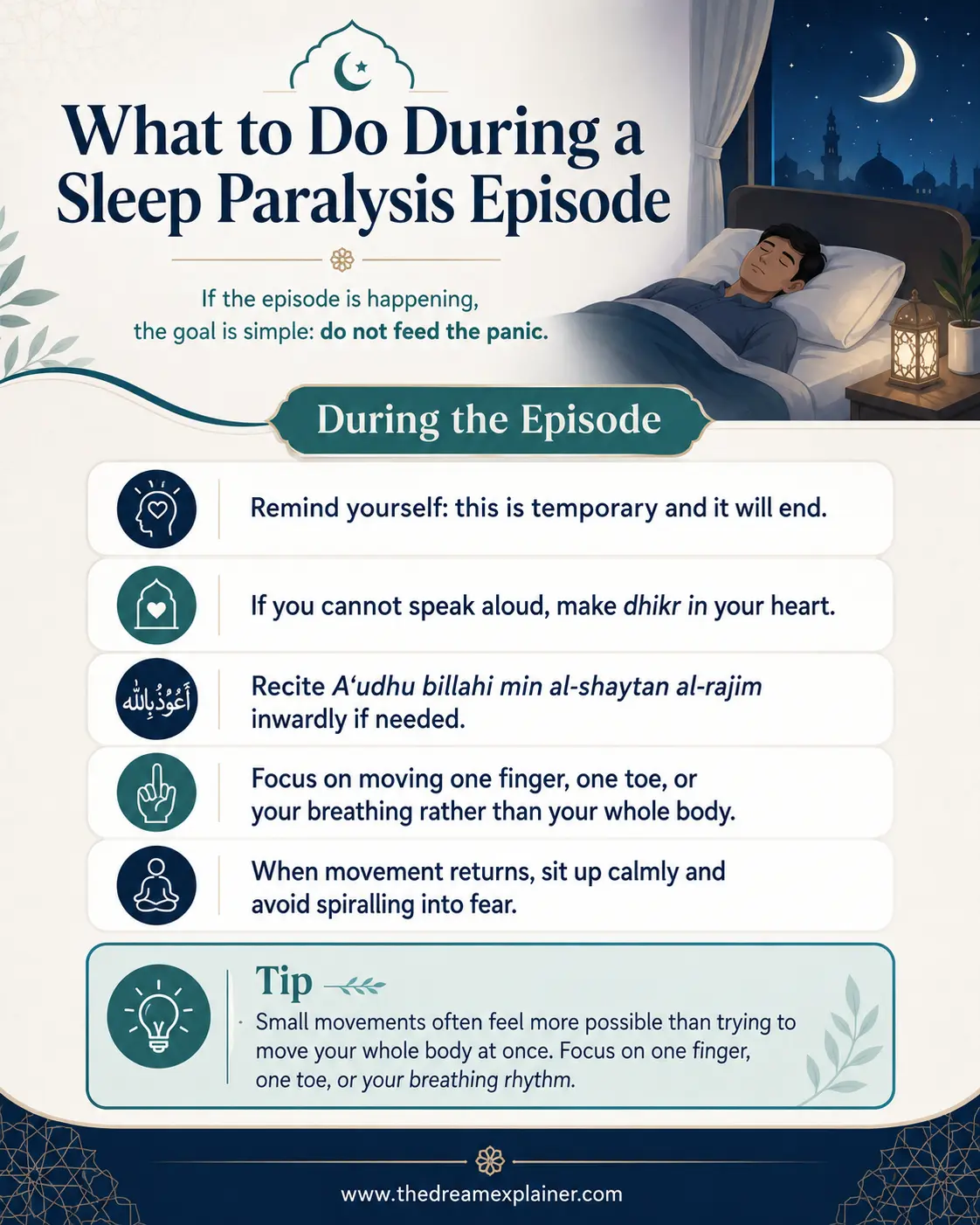
During an episode
- Remind yourself that sleep paralysis is temporary.
- Try to remain calm rather than struggling against the sensation.
- Remember Allah inwardly if you wish.
- Focus on steady breathing or attempt a small movement, such as moving a finger or toe.
- Allow normal movement to return before getting up.
Small movements and focusing on breathing are practical calming strategies, not specifically prescribed Prophetic treatments for sleep paralysis.
What should you do after the episode?
Once movement returns, sit up calmly and allow the fear to settle. If the experience included a frightening dream, you may follow the Sunnah response for disliked dreams.
For detailed guidance, see what to do after a bad dream in Islam.
Du‘ā for Sleep Paralysis in Islam and Bedtime Protection
There is no specific authenticated du‘ā established exclusively for sleep paralysis. However, Muslims may seek Allah’s protection using authentic supplications and bedtime adhkār.
If you cannot speak during an episode, you may remember Allah inwardly. There is no need to force speech or assume your inability to recite aloud indicates spiritual harm.
Seeking refuge with Allah
أَعُوذُ بِاللَّهِ مِنَ الشَّيْطَانِ الرَّجِيمِ
A‘ūdhu billāhi min ash-Shayṭān ir-rajīm.
Meaning: I seek refuge with Allah from Satan, the rejected.
This is a general phrase of seeking protection, not a supplication specific to sleep paralysis.
1. Reciting Āyat al-Kursī before sleep
Āyat al-Kursī is Qur’an 2:255. Sahih al-Bukhari 2311 reports a narration concerning recitation of this verse before sleeping and Allah’s protection through the night.
Read Āyat al-Kursī, Qur’an 2:255 and Sahih al-Bukhari 2311.
2. Reciting the three protective sūrahs
The Prophet ﷺ recited Sūrat al-Ikhlāṣ, Sūrat al-Falaq, and Sūrat al-Nās before sleep, as reported in Sahih al-Bukhari 5017.
These are established bedtime recitations, not guaranteed medical cures for sleep paralysis.
3. Wuḍū’ and sleeping on the right side
Sahih al-Bukhari 247 records guidance to perform wuḍū’ before sleeping and lie on the right side.
Following this Sunnah can form part of a peaceful bedtime routine without treating a particular sleeping position as a diagnosis of spiritual harm.
4. Complete bedtime du‘ā routine
Additional authentic bedtime remembrance includes short supplications, Qur’anic recitation, and remembrance of Allah.
Read our du‘ā before sleeping in Islam guide for a fuller routine.
How to Stop or Reduce Sleep Paralysis
There is no single method guaranteed to prevent every episode. However, improving sleep habits may reduce recurrence for some people.
| Helpful habit | Practical application |
|---|---|
| Consistent sleep schedule | Go to sleep and wake at approximately the same time each day. |
| Adequate sleep | Aim for sufficient sleep and avoid repeated sleep deprivation. |
| Reduce sleep disruption | Limit late caffeine and other habits that interfere with sleep. |
| Adjust sleeping position | Try avoiding sleeping on your back if episodes seem associated with that position. |
| Manage stress | Build a calmer evening routine and address recurring worries. |
| Maintain bedtime adhkār | Use authentic Islamic remembrance as worship and spiritual reassurance. |
Islamic bedtime habits
Reciting Āyat al-Kursī, the three protective sūrahs, and other authentic adhkār can form part of a consistent Muslim bedtime routine.
These practices should not be marketed as a guaranteed prevention or cure for a recognised sleep-related condition.
Tracking recurring episodes
If episodes happen repeatedly, consider recording your sleep schedule, stress, sleep position, episode frequency, and daytime sleepiness.
This may help identify patterns and provide useful information when discussing the experience with a healthcare professional.
Can Sleep Paralysis Kill You in Islam?
Ordinary sleep paralysis is generally not life-threatening. It can feel dangerous because of temporary immobility, pressure sensations, and intense fear, but these features do not mean that death is approaching.
There is no authentic basis for claiming that an ordinary sleep paralysis episode indicates a jinn is killing someone or that the person’s death has been predicted.
Sleep paralysis usually resolves on its own. However, symptoms occurring outside the normal sleep-wake transition should not automatically be assumed to be harmless sleep paralysis.
When urgent attention is necessary
Sudden paralysis or weakness while fully awake, particularly with facial drooping, difficulty speaking, severe chest pain, severe breathing difficulty, or confusion, requires urgent medical attention.
Do not dismiss these symptoms as ordinary sleep paralysis.
When should you see a doctor?
Occasional episodes may not require treatment. Seek medical advice when sleep paralysis happens often, causes fear of sleeping, affects your daytime energy, or occurs alongside other concerning sleep symptoms.
Marked daytime sleepiness or sudden sleep attacks may warrant assessment for an underlying sleep disorder.
See the NHS guidance and Cleveland Clinic sleep paralysis guide.
Sleep Paralysis, Bad Dreams, Siḥr and Ruqyah
Sleep paralysis versus a frightening dream
During sleep paralysis, you may become aware of your surroundings but temporarily cannot move. In a nightmare, you usually experience events within the dream itself.
Sometimes dream-like imagery continues into an episode of sleep paralysis, making the experiences difficult to distinguish.
What the Sunnah teaches after disliked dreams
In Sahih al-Bukhari 6986 and Sahih Muslim 2261a, the Prophet ﷺ taught seeking Allah’s protection and lightly spitting to the left three times after a disliked dream.
Related authentic narrations mention changing sleeping sides and avoiding unnecessarily spreading frightening dreams.
These are teachings about disliked dreams. They should not be inaccurately described as specific medical treatments for sleep paralysis.
Does sleep paralysis mean siḥr or possession?
Sleep paralysis alone cannot establish siḥr, jinn involvement, the evil eye, or possession.
Be cautious of anyone offering a certain supernatural diagnosis solely on the basis of sleep paralysis or charging for a supposedly necessary treatment based on that claim.
Is ruqyah required for sleep paralysis?
A sleep paralysis episode does not by itself create an obligation to undergo ruqyah.
Authentic Qur’anic recitation, du‘ā, and remembrance can be practised as worship without assuming that an unseen affliction exists. Recurring episodes should also be evaluated through appropriate sleep and medical care.
Psychological perspective
From a psychological perspective, sleep paralysis can become especially frightening because awareness, immobility, and dream-like perceptions occur together. Fear or stress may intensify distress surrounding the experience, while worries about another episode may disrupt sleep further. These associations do not diagnose a mental health condition or establish a supernatural cause.
If your experience was mainly a dream in which a jinn threatened or chased you, see our jinn attacking in a dream guide for that separate dream scenario.
Frequently Asked Questions
What is sleep paralysis in Islam?
Sleep paralysis is a recognised sleep-related state in which someone is aware but temporarily unable to move or speak. Islam encourages remembrance of Allah but does not establish the condition as proof of possession or jinn involvement.
Why does sleep paralysis happen in Islam?
Sleep paralysis may happen when awareness returns before REM-related muscle immobility ends. Sleep deprivation, irregular schedules, stress, and other sleep-related factors may contribute.
Is sleep paralysis caused by jinn?
Sleep paralysis alone is not evidence of jinn activity. Its recognised sleep-related mechanisms can explain temporary immobility, a sensed presence, and frightening perceptions.
Which jinn causes sleep paralysis?
No specific named jinn is authentically established as the cause of sleep paralysis. It is not appropriate to diagnose an unseen being from symptoms alone.
What du‘ā should I recite for sleep paralysis?
There is no specific authenticated du‘ā exclusive to sleep paralysis. You may seek refuge with Allah and maintain authentic bedtime remembrance, including Āyat al-Kursī and the three protective sūrahs.
Can sleep paralysis kill you in Islam?
Ordinary sleep paralysis is generally not life-threatening and does not predict death. Sudden neurological symptoms while fully awake or severe breathing problems require urgent medical assessment.
What does the Qur’an say about sleep paralysis?
The Qur’an discusses sleep and the unseen but does not specifically identify sleep paralysis or establish that it is caused by jinn. Qur’an 30:23 mentions sleep as one of Allah’s signs.
How can I stop sleep paralysis in Islam?
Maintain authentic bedtime adhkār and improve sleep habits, including a regular schedule and adequate rest. If episodes recur or interfere with sleep, seek qualified medical advice. No method guarantees complete prevention.
When should I seek medical help?
Seek medical assessment when episodes are frequent, cause fear of sleeping, result in daytime tiredness, or occur alongside severe daytime sleepiness or other concerning symptoms.
Final Reflection
Sleep paralysis in Islam can be approached through both understanding and faith. Its recognised sleep-related explanation helps account for temporary immobility and frightening perceptions, while Islamic remembrance provides spiritual reassurance.
Sleep paralysis does not automatically establish jinn involvement, possession, or siḥr. Maintain authentic bedtime worship, develop healthy sleep habits, and seek suitable medical care if episodes become frequent or disruptive.
Allah knows best.
Islamic and Medical Sources
- Qur’an 30:23 — sleep as one of Allah’s signs.
- Sahih al-Bukhari 6986 — guidance for disliked dreams.
- Sahih Muslim 2261a — seeking refuge after a frightening dream.
- Sahih al-Bukhari 2311 — reciting Āyat al-Kursī before sleeping.
- Sahih al-Bukhari 5017 — bedtime recitation of protective sūrahs.
- Sahih al-Bukhari 247 — wuḍū’ and sleeping on the right side.
- NHS — symptoms, triggers, and medical guidance.
- Cleveland Clinic — medical overview and recurring symptoms.
- Sleep Foundation — REM sleep and associated perceptions.
Editorial note: This article offers educational Islamic and sleep-health information, not a fatwa, medical diagnosis, or confirmation of unseen causes. Sleep symptoms should be assessed using appropriate medical evidence, and religious guidance should be understood within its authentic context.