 The Dream Explainer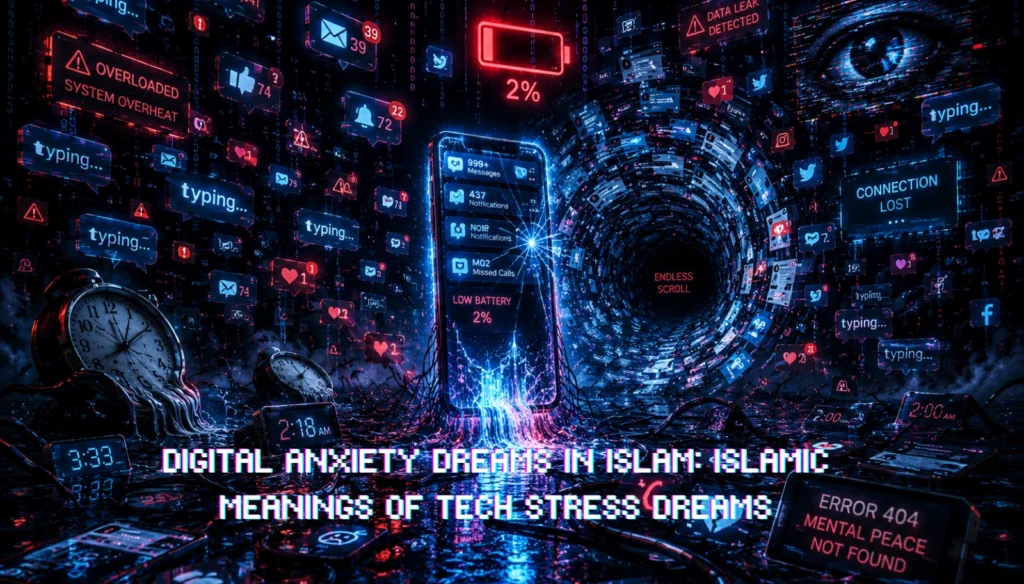
Digital Anxiety Dreams in Islam: Meanings of Tech Stress Dreams
Quick Answer
Digital anxiety dreams in Islam — missed meetings, crashing laptops, lost files, internet failure — almost always fall under Ḥadīth al-Nafs, the category of dreams generated by the soul’s own stress and emotional state. They do not predict harm. Islam responds with tawakkul, dhikr, and a return to balance.
You wake up unsettled. You missed a critical Zoom call, watched your laptop screen go black, or lost every file you had worked on for months. The dream felt completely real — and now you cannot shake the feeling that something is wrong.
Islam gives believers a clear, grounded framework for reading these experiences. The Prophet ﷺ taught that not every disturbing dream carries a divine message — and that knowledge alone removes most of the fear.
This guide applies classical Islamic dream principles to digital anxiety dreams: what they mean, which scholars speak to them, and exactly what a believer should do after waking from one.
How Islam Classifies Anxiety Dreams
The Three Categories Every Muslim Needs to Know
The Prophet ﷺ said: “Dreams are of three types: a glad tiding from Allah, what is on a person’s mind, and frightening dreams from Shaytan.” (Tirmidhi 2391)
Islam names these three categories precisely. Ru’yā is the true vision — a clear, calm dream that comes from Allah and often carries a glad tiding or a warning. Ḥulm is the disturbing dream that Shaytan uses to cause fear. Ḥadīth al-Nafs is the soul talking to itself — the mind replaying stress, unresolved emotions, and daily overload during sleep.
Digital anxiety dreams almost never belong to the first two categories. They belong to the third.
Why Technology Dreams Belong to Ḥadīth al-Nafs
Ibn Sīrīn (d. 110 AH, rahimahullah), author of Tafsīr al-Ahlām, taught that a dream reflects the dreamer’s dominant preoccupations. A person who spends eight to twelve hours a day in front of screens will naturally dream about those screens.
Abd al-Ghani al-Nābulusī (d. 1143 AH, rahimahullah), in Ta’tīr al-Anām fī Tafsīr al-Ahlām, emphasised that dream meanings depend entirely on the dreamer’s circumstances, emotional state, and life context.
A crashing laptop dreamed by an exhausted software developer means something different from the same dream seen by a person with no relationship to screens at all. Context governs interpretation.
When a Disturbing Dream Might Be Ḥulm
The Prophet ﷺ said: “If any one of you sees a dream that he dislikes, he should spit to his left three times, seek refuge with Allah from Shaytan, and turn over to his other side.” (Sahih Muslim 2261)
If a tech dream carries an overwhelming sense of dread far beyond normal stress — or if it repeats alongside other spiritual disturbances — the believer applies the Sunnah response without excessive analysis.
The goal is never obsession with the dream’s source. The goal is calm, trust in Allah, and a return to balance.
What Digital Symbols Mean Through a Classical Lens
How Classical Scholars Read Modern Tools
Classical scholars never encountered laptops, Wi-Fi, or Zoom. But their interpretive method — reading symbols through their function, not their form — applies perfectly to modern technology.
Ibn Sīrīn (rahimahullah) consistently read tools by what they do: a pen symbolises knowledge and record-keeping; a messenger symbolises communication; a house symbolises the self and family. These principles map directly onto digital equivalents.
A laptop — a tool of work, knowledge, and livelihood — carries the same symbolic weight as classical tools of craft and trade. The internet — a channel of communication and information — carries the weight of classical messengers and roads.
The Core Symbolic Register of Digital Objects
- Laptop or computer — work, livelihood, knowledge, productivity
- Internet connection — communication, access, relationships, opportunity
- Files and data — accumulated effort, knowledge, memory, accountability
- Online meeting or gathering — duty, responsibility, social standing
- Notifications and alerts — demands on attention, responsibilities, obligations
Al-Nābulusī (rahimahullah) wrote that any object associated with a person’s livelihood carries particular weight in dream interpretation — because livelihood connects directly to trust, provision, and reliance on Allah.
“And whoever relies upon Allah — then He is sufficient for him. Indeed, Allah will accomplish His purpose.” (Quran 65:3)
Dream Scenarios and Their Islamic Meanings
What does it mean to dream of missing a Zoom meeting in Islam?
Missing a Zoom meeting in a dream most commonly reflects performance anxiety, fear of professional failure, or worry about disappointing others. The meeting — a gathering with duties and expectations attached — symbolises responsibility in the classical sense.
Ibn Shaheen (d. 388 AH, rahimahullah), author of Muntakhab al-Kalām fī Tafsīr al-Ahlām, noted that dreams of missing appointments and arriving late reflect the dreamer’s internal fear of inadequacy rather than any prediction of failure.
The dream invites the believer to examine where that fear comes from — and to replace it with sincere effort and tawakkul.
Internet down dream meaning in Islam
Dreaming of lost internet access may symbolise blocked communication, a sense of isolation, or fear of being cut off from opportunity. The connection that sustains livelihood and relationships disappears — and the dreamer feels helpless.
Al-Nābulusī (rahimahullah) interpreted blocked roads and severed communication lines as symbols of temporary difficulty, not permanent loss. The disruption passes.
Spiritually, this dream reminds the believer that no system of this world is permanent. Only Allah’s provision is uninterrupted.
Laptop crashing dream meaning in Islam
A crashing laptop in a dream points directly at mental overload. The tool that carries the dreamer’s work, income, and knowledge breaks down — mirroring what the dreamer’s mind and body are experiencing.
Ibn Sīrīn (rahimahullah) read the failure of a person’s primary tool of work as a signal of exhaustion and a prompt to rest and reassess. It does not indicate that the work itself will fail.
The Islamic response is tawakkul: do what is in your hands, then release the outcome to Allah entirely.
Losing files dream interpretation in Islam
Lost files in a dream may carry the weight of lost knowledge, forgotten duty, or fear that sustained effort will count for nothing. Files represent what the dreamer has built, stored, and protected.
In the classical framework, losing written records connects to anxiety about accountability — both worldly and spiritual. The dreamer may be asking, subconsciously: does my effort matter?
Islam answers clearly: nothing sincere is ever lost. Allah preserves every deed, every effort, every intention.
Tech malfunction dream Islam interpretation
Devices that freeze, glitch, or behave erratically in a dream often mirror a life that feels unstable and beyond the dreamer’s control. The machine that is supposed to obey simply does not.
Ibn Sīrīn (rahimahullah) read uncontrollable tools as a symbol of circumstances that require patience rather than force. Pushing harder does not fix a glitching screen — and it does not fix every life problem either.
For related technology symbolism, read about technology dreams in Islam and communication dreams in Islam.
What to Do After a Disturbing Tech Dream
Islam does not leave the believer alone after a bad dream. The Prophet ﷺ gave a complete set of protective actions — simple, immediate, and spiritually grounding.
The Sunnah Response — Step by Step
- Say A’ūdhu billāhi min al-Shayṭān al-rajīm immediately upon waking.
- Spit lightly to the left three times.
- Do not share the dream with others.
- Turn onto your other side.
- Recite Āyat al-Kursī (Quran 2:255) and the final two verses of Sūrah al-Baqarah (2:285–286).
- Rise and pray two rak’ahs if the heart remains unsettled.
These steps come directly from Sahih Muslim 2261. They are not optional extras — they are the complete prophetic response to any disturbing dream.
Addressing the Root Cause
If digital anxiety dreams recur, they are carrying a message — not a divine prophecy, but a signal from your own state. The believer should ask honestly: how much of the day is spent before a screen? When does that exposure end before sleep?
Islam teaches balance across all domains: worship, rest, work, family. Chronic imbalance in any one area will surface in the dream state.
Reduce screen time in the hour before sleep. Establish a consistent dhikr practice at bedtime. Pray Witr. These are the real remedies — and they are permanent ones.
For a complete guide, read what to do after a bad dream in Islam.
Frequently Asked Questions
Are digital anxiety dreams a warning in Islam?
Digital anxiety dreams are rarely divine warnings. Classical Islamic scholars distinguish between ru’yā (true vision from Allah), ḥulm (from Shaytan), and Ḥadīth al-Nafs (the soul’s own thoughts). Most tech stress dreams fall into the third category — the mind processing daily pressure and exhaustion.
What does it mean to dream of missing a Zoom meeting in Islam?
Dreaming of missing a Zoom meeting in Islam may reflect fear of failure, performance anxiety, or worry about falling short of responsibilities. Ibn Shaheen (d. 388 AH) noted that dreams of lateness and missed gatherings often mirror the dreamer’s waking stress rather than foretelling any future event.
What does a laptop crashing in a dream mean in Islam?
A laptop crashing in a dream may symbolise mental overload, exhaustion, or fear that responsibilities will collapse under pressure. Since the laptop represents work and productivity, its failure in a dream often points to burnout. Islam encourages the believer to respond with tawakkul — sincere effort followed by full trust in Allah.
Why do I keep dreaming about losing files or data?
Recurring dreams about losing files may reflect anxiety about wasted effort, fear of being forgotten, or insecurity about achievements. In Islamic symbolism, stored knowledge and written records connect to accountability and trust. These dreams often invite the believer to release attachment to outcomes and trust Allah’s preservation.
Can burnout and screen overload cause disturbing dreams in Islam?
Yes. Islamic teaching recognises Ḥadīth al-Nafs — dreams generated by the soul’s own emotional state. Chronic screen overload, stress, and exhaustion directly fuel this category of dream. Islam encourages believers to limit digital exposure before sleep, increase dhikr, and restore balance through prayer and rest.
Closing Thoughts
A crashing screen, a lost connection, a meeting missed by seconds — these dreams feel urgent because the pressures behind them are real. But Islam places them exactly where they belong: signals from a tired soul, not warnings from the unseen.
The believer responds with the Sunnah, with honest self-reflection, and with renewed tawakkul. The dream is not the problem — the imbalance that produced it is. And Islam has always known how to correct that.
To deepen your understanding of how Islam reads privacy and security fears in the digital world, read privacy and security dreams in Islam.
Related Dream Guides
These articles explore connected themes in Islamic dream interpretation.