
Dreams in Ramadan Meaning in Islam: 7 Spiritual Meanings Explained

2Do Dreams in Ramadan Have Greater Meaning in Islam?
3Three Types of Dreams in Islam
4Why Dreams Feel More Real in Ramadan
5Signs of a Genuine Ru’ya in Ramadan
6What Classical Scholars Said About Dreams in Ramadan
77 Ramadan Dream Scenarios — Islamic Meanings Explained
8Nightmares in Ramadan Islam — The Sunnah Protocol
9Quick Reference: Ramadan Dream Meanings in Islam
10Islamic Ruling: Can Dreams Be Used as Guidance?
Dreams in Ramadan in Islam are considered more spiritually significant than dreams at other times of year. Scholars attribute this to reduced Shaytan influence (due to his chaining), the heightened spiritual state of the fasting believer, and the increased likelihood of true dreams (Ru’yā Ṣāliḥah) during periods of intense worship. The Prophet ﷺ received the first revelation in Ramadan, and the Islamic tradition holds that the barrier between the believer’s soul and divine communication is at its thinnest during this sacred month.
Dreams in Ramadan Meaning in Islam: 7 Spiritual Meanings Explained

During Ramadan, many Muslims notice something unmistakably different about their sleep. Dreams feel more real in Ramadan — scenes stick in the mind long after fajr, emotions carry unusual weight, and sometimes a dream stays with you for days. That experience leads to one of the most searched spiritual questions in the Muslim world: what is the dreams in Ramadan meaning in Islam, and do these dreams carry deeper messages?
The honest Islamic answer is nuanced. Islam honors true dreams (ru’ya), gives believers tools to handle nightmares, and firmly keeps the faith grounded — dreams may inspire you, but they never replace Qur’an or Sunnah. This guide covers everything: Ramadan dreams meaning according to classical scholars, the signs of a genuine ru’ya in Ramadan, why your sleep feels spiritually charged during fasting, the meaning of seeing Ramadan itself in a dream, dreaming about eating while fasting, doing iftar in dream Islam, dreaming of a feast in Islam, and a full protocol for handling nightmares in Ramadan Islam.
Dreams in Ramadan meaning in Islam: Islam classifies all dreams into ru’ya (true dreams from Allah), hulm (nightmares from Shaytan), and hadith an-nafs (self-talk from daily thoughts). Ramadan’s spiritual environment — fasting, increased worship, and reduced sin — may create conditions for more true dreams. However, not every vivid Ramadan dream is divinely significant. Vividness is not proof of divine origin, and dreams never override Qur’an or Sunnah.
2Do Ramadan Dreams Have Greater Meaning?
3Three Types of Dreams in Islam
4Why Dreams Feel More Real in Ramadan
5Signs of a Ru’ya in Ramadan
6What Classical Scholars Said
77 Ramadan Dream Scenarios Explained
8Nightmares in Ramadan: Sunnah Protocol
9Quick Reference Table
10Islamic Ruling: Dreams as Guidance
11FAQs — People Also Ask
12Summary & Final Thoughts
What Is the Dreams in Ramadan Meaning in Islam?
Dreams in Ramadan meaning in Islam refers to the spiritual, psychological, and legal understanding of dreams experienced during the blessed month of Ramadan — the month of fasting, Qur’an, Taraweeh, and intensified worship. Islam doesn’t treat Ramadan dreams as a separate category with special rules. The same three-category framework applies year-round. What changes in Ramadan is the conditions — and conditions, according to classical scholars, do influence the frequency and clarity of true dreams (ru’ya).
Understanding Ramadan dreams meaning correctly requires knowing the Islamic framework first. Without it, believers often fall into two opposite errors: dismissing every dream entirely, or treating every vivid dream as a divine sign. Both extremes are mistaken. Islam’s framework protects against both.
If you’ve been waking up this Ramadan with dreams that feel unusually significant, you’re not imagining it — and the Islamic tradition on dreams has a remarkably sophisticated answer for why.
Do Dreams in Ramadan Have Greater Meaning in Islam?
The question Muslims most ask: are Ramadan dreams more likely to be true? The scholarly answer is carefully balanced. Ramadan doesn’t automatically make all dreams meaningful — but it does create the spiritual conditions that classical scholars identified as favorable for receiving true dreams.
“When Ramadan begins, the gates of Paradise are opened, the gates of Hell are closed, and the devils are chained.”
When the major sources of spiritual disruption are removed and the believer’s heart is consistently turned toward Allah through fasting, Qur’an recitation, and night prayer — the internal landscape becomes quieter and more receptive. Classical scholars consistently linked this kind of internal state to the frequency of ru’ya in Ramadan.
The key distinction to hold in mind:
- ✓Ramadan creates favorable conditions — more worship, less sin, purer intention, sleeping with wudu more often
- ✓Favorable conditions increase the likelihood of receiving a true dream — but do not guarantee every dream is one
- ✓Vividness is not proof — hunger, shifted sleep schedules, and emotional intensity also produce vivid dreams with no spiritual significance
- ✓A true dream never contradicts Qur’an or Sunnah — if it does, it is not a ru’ya regardless of how clear it felt
Three Types of Dreams in Islam
Every discussion of dreams in Ramadan meaning in Islam must begin here. The Prophet ﷺ established the foundational classification that all Islamic dream scholarship is built on:
“Dreams are of three types: a righteous dream which is glad tidings from Allah, a dream from Shaytan to cause grief, and a dream from what a person thinks about while awake.”
Ru’ya Salihah — From Allah
A true dream is one of the most precious gifts a believer can receive. It comes with clarity, calmness, and a feeling that stays with you after waking. The Prophet ﷺ said: “The true dream of a righteous man is one of forty-six parts of prophethood.” (Sahih al-Bukhari 6983). A ru’ya never contradicts Islamic teachings — it aligns with them, reinforces them, or provides comfort within them.
Semantic signs: spiritual clarity, tawbah (repentance), du’a answered, proximity to Allah, Quranic imagery, angelic presence, guidance
Hulm — From Shaytan
Nightmares are sent by Shaytan to cause grief, anxiety, or confusion. They hold no prophetic meaning and should never be interpreted or shared. The fact that devils are chained in Ramadan does not eliminate all sources of disturbing dreams — human weakness, stress, fatigue, and hunger can produce disturbing dreams independently.
Semantic signs: fear, panic, disturbing imagery, waking up distressed, scenes of harm, spiritual anxiety, darkness
Hadith an-Nafs — From Daily Thoughts
The most common type — and in Ramadan, the most frequently mistaken for ru’ya. These dreams reflect what the mind has been processing: food thoughts while fasting, worship imagery from Taraweeh, anxiety about finishing Qur’an, anticipation of iftar, family dynamics, work stress. Vivid, emotionally charged, easily remembered — but entirely self-generated.
Semantic signs: food dreams, familiar people, daily routines, anxiety scenarios, wish fulfilment, sensory intensity tied to hunger or thirst
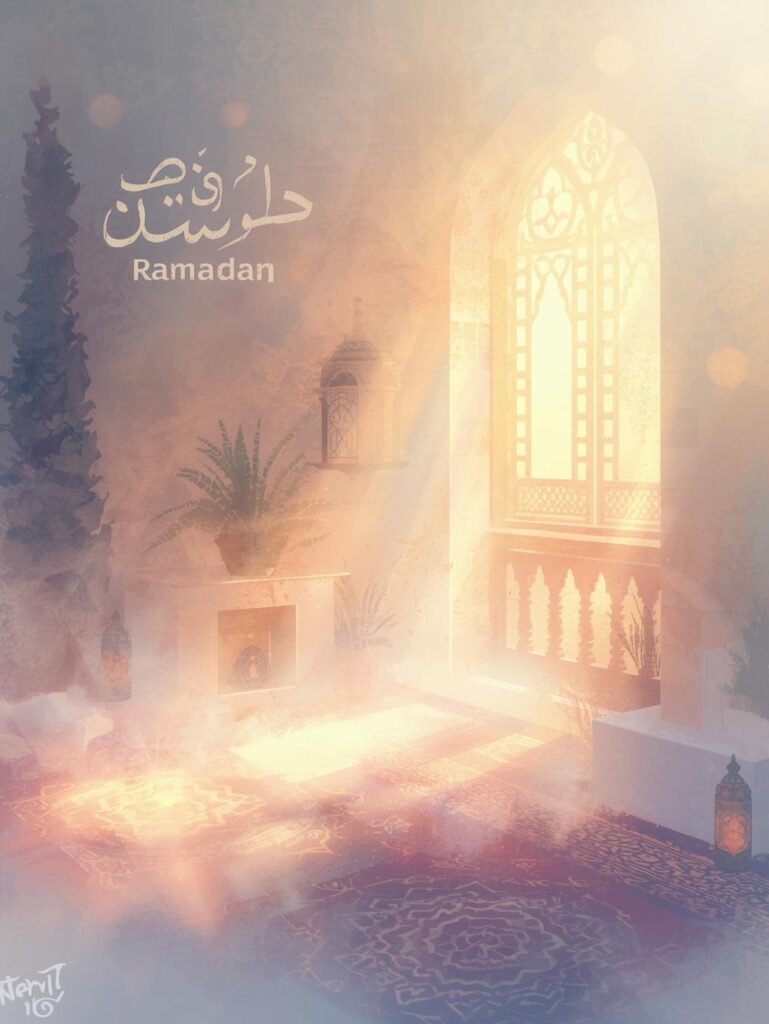
Ramadan creates a unique spiritual landscape — increased worship, reduced sin, and consistent remembrance of Allah all shape the dreaming mind
Why Dreams Feel More Real in Ramadan
Across cultures and continents, Muslims consistently report that dreams feel more real in Ramadan — more emotionally intense, more easily remembered, more symbolically rich. This isn’t imagination. There are clear physical, neurological, and spiritual reasons:
- 1Fragmented sleep cycles
Taraweeh extends late into the night. Suhoor requires waking before fajr. This creates multiple distinct sleep periods — and each return to sleep tends to involve longer, more vivid REM phases. More REM means more dreams recalled in detail. - 2Physiological effects of fasting
Hunger and mild dehydration alter neurotransmitter balance and can intensify dream imagery. The brain, deprived of its usual food-signal distractions, processes and projects more vividly during sleep. - 3Qur’an and dhikr before sleep
The last content the mind processes before sleep directly shapes what dreams emerge from. An evening filled with Qur’anic recitation, Taraweeh prayer, and dhikr seeds the subconscious with rich spiritual material. - 4Heightened emotional and spiritual state
Ramadan carries a distinct emotional register — hope for forgiveness, fear of wasted days, longing for Laylat al-Qadr, awareness of accountability. These powerful feelings are processed during sleep. - 5Reduced worldly noise
Less socialising, less entertainment, reduced screen time, earlier nights — the mind has less clutter to dream through, making spiritually-charged content more prominent and memorable. - 6Spiritual receptivity (the Islamic dimension)
Ibn Sirin رحمه الله taught that a pure heart, engaged in sincere worship and free from major sin, becomes more receptive to true dreams. Ramadan is the annual peak of that spiritual state for millions of believers simultaneously.
Signs of a Genuine Ru’ya in Ramadan
How do you know whether a Ramadan dream was a ru’ya or simply a vivid hadith an-nafs? Classical scholars outlined consistent signs:
- ✓You remember it clearly upon waking — not reconstructed, but vividly present in memory, often for days
- ✓It has a calm, ordered quality — not chaotic, fragmentary, or anxiety-soaked
- ✓It leaves your heart settled — even if the content was serious or sobering, you wake up feeling grounded, not panicked
- ✓It aligns completely with Islamic teachings — nothing in the dream contradicts Qur’an or Sunnah
- ✓It moves you toward goodness — toward repentance (tawbah), gratitude (shukr), increased salah, charity, or mending relationships
- ✓It does not make you feel “chosen” or superior — genuine ru’ya produces humility and closer connection to Allah, not spiritual arrogance
What Classical Scholars Said About Dreams in Ramadan
No classical scholar declared Ramadan a guaranteed window of prophetic dreams. What they consistently taught was that spiritual conditions — which Ramadan cultivates intensively — increase a believer’s receptivity to true dreams.
“The sincerity of the dreamer is the first criterion of interpretation. A person who fasts genuinely, guards their tongue, and sleeps in a state of purity will see more clearly in sleep than one who is heedless — just as they see more clearly in their waking life.”
“True dreams are more likely to occur when a person is truthful in their dealings, avoids prohibited matters, and sleeps in a state of ritual purity. These are precisely the conditions that Ramadan encourages a believer to maintain throughout the entire month.”
Both scholars also consistently warned against two related errors: treating every dream as meaningful, and sharing dreams indiscriminately. Ibn Qutaybah رحمه الله added that a dream is only as reliable as the dreamer’s understanding of Islamic principles — an accurate dream can be badly misread by someone lacking Islamic knowledge. This is why the framework of Islamic dream interpretation matters so much before attempting to understand any specific dream.
7 Ramadan Dream Scenarios — Islamic Meanings Explained
These are the most spiritually significant and most searched dream scenarios that occur specifically during or in relation to Ramadan, with their classical Islamic interpretations:
1. Seeing Ramadan in a Dream (Islamic Meaning)
Seeing Ramadan in dream Islam — actually witnessing the month itself, its atmosphere, its spiritual weight — is one of the most hopeful dream scenarios in Islamic interpretation. Scholars associate it with: divine mercy drawing near, a call to sincere repentance before it is too late, a reminder that the gates of forgiveness are still open, and hope for renewal of one’s relationship with Allah.
If you see Ramadan arriving in a dream during a period of spiritual neglect, take it as a deeply merciful nudge. If you see Ramadan ending prematurely or passing without you, reflect on what spiritually you may be losing through heedlessness.
2. Spiritual Meaning of Fasting in a Dream
The spiritual meaning of fasting in a dream, according to Ibn Sirin رحمه الله, centers on restraint, sincerity, and internal discipline. Fasting in a dream symbolizes: guarding the tongue from sin and falsehood, patience through a current hardship, sincerity in your worship and intentions, protection from wrongdoing you may be close to committing, and spiritual self-mastery that your soul is working toward.
This dream often appears when the dreamer is in a period of genuine spiritual striving — the nafs seeking discipline is expressing itself in the dream language of fasting. It is a confirmation, not a guarantee of reward.
3. Dreaming About Eating While Fasting
Dreaming about eating while fasting is the single most searched Ramadan dream topic — and the most misunderstood. Believers often wake up alarmed, wondering if their fast is broken or if they have sinned. The clear Islamic answer on both counts:
- ✓Your fast is completely valid — dreams carry no legal consequence in Islamic jurisprudence. What occurs while unconscious is not held against the believer.
- ✓You committed no sin — intention and conscious action are required for sin. Neither exists in a dream.
- ✓Eating unintentionally in the dream — most likely reflects hunger, routine food associations, or Allah’s mercy (He forgives those who eat forgetfully even while awake).
- ✓Deliberately breaking the fast in the dream — may reflect inner anxiety, guilt about something unrelated to fasting, or a fear of spiritual slipping. A reminder for mindfulness, not a prophecy.
4. Doing Iftar in Dream (Islamic Meaning)
Doing iftar in dream Islam is one of the most comforting dream scenarios. The symbolic weight of iftar — the moment of completion, relief, and gratitude after a long day of sacrifice — translates directly into its dream meaning. Scholars interpret it as: the end of a difficult phase of life approaching, relief from hardship that has been long-waited for, a du’a that has been heard and will be answered, completion of a spiritual or worldly endeavour, and gratitude that Allah is asking you to express more consciously.
Many believers report seeing iftar dreams during periods of sustained difficulty or long periods of waiting for an answer to du’a. The Islamic interpretation is consistent: be patient. Relief is written. The iftar moment is coming in your waking life too.
5. Dreaming of a Feast in Islam
Dreaming of a feast in Islam — an abundant table, a gathering of people around food, celebration and sharing — carries layered meanings entirely dependent on the atmosphere and feeling of the dream.
- ✓Joyful, calm, generous feast — lawful provision and abundance approaching, community and family bonds strengthening, gratitude for blessings already given, spiritual celebration (a personal Eid of the soul)
- ✓Chaotic, excessive, or anxious feast — over-attachment to dunya and material comfort, distraction from spiritual purpose, a gentle warning to recalibrate priorities before Ramadan ends
Note: dreaming of forbidden food (pork, alcohol) does not carry those prohibitions into the spiritual meaning — Ibn Sirin interpreted such dreams symbolically rather than literally.
6. Dreaming of Laylat al-Qadr or the Last Ten Nights
Some believers dream of an unusually radiant night, of angels descending, or of an atmosphere of profound stillness and light that they intuitively associate with Laylat al-Qadr — the Night of Decree. Ibn Sirin and subsequent scholars interpreted such dreams as: a call to maximise the last ten nights, spiritual readiness that Allah is acknowledging, and a reminder that the night’s rewards are within reach for anyone who sincerely seeks them.
No dream can confirm that you have specifically witnessed Laylat al-Qadr — that knowledge belongs to the unseen. But a dream that fills you with longing for these nights and motivates you to stand in qiyam is doing exactly what a true dream should do.
7. Seeing the Prophet ﷺ in a Dream During Ramadan
While not exclusive to Ramadan, this dream is reported more frequently during the blessed month. It holds a special status in Islamic dream scholarship that no other dream does:
“Whoever sees me in a dream has truly seen me, for Shaytan cannot take my form.”
If you see the Prophet ﷺ in a recognizable form — consistent with his descriptions in the Seerah — this is among the most blessed experiences a believer can have. Respond by increasing salah upon him (Salawat), deepening your connection to the Sunnah, and letting it renew your love for the deen. See the complete guide: Seeing the Prophet ﷺ in a Dream — Islamic Meaning →
🌙 Get Your Ramadan Dream Interpreted — Free
Describe what you saw — angel, iftar, fasting, feast, the Prophet ﷺ, or anything else. The Dream Explainer gives you a personalised Islamic interpretation in seconds, built on Ibn Sirin, Imam al-Karmani, and authenticated Hadith. No sign-up. Completely free.
Nightmares in Ramadan Islam — The Sunnah Protocol
The most common point of confusion: “If Shaytan is chained in Ramadan, why am I still having nightmares in Ramadan Islam?” The scholars address this directly.
Nightmares in Ramadan do not predict the future or signal divine displeasure — the Prophetic protocol dismisses them immediately
The Prophet ﷺ gave specific, practical guidance for handling bad dreams. Follow this sequence:
- Spit lightly to your left three times (ta’awwudh spitting)
A dry, symbolic spit — not actual expectoration. It is an act of dismissal rooted in Prophetic guidance. - Say A’udhu billahi min ash-shaytaan ir-rajeem
“I seek refuge in Allah from the accursed Shaytan.” Say it three times with conviction. - Do not tell anyone
Sharing a nightmare gives it power it does not deserve. The Prophet ﷺ was explicit about this — silence is the correct response. - Change your sleeping position
Roll to the other side. This simple physical act shifts both posture and mental state, interrupting the cycle. - Get up and pray two rak’ahs if needed
Not obligatory, but if the disturbance persists, prayer is the most powerful grounding available to a believer. - Refuse all attempts to interpret it
Do not search online, do not ask a scholar about it, do not tell family members. A nightmare carries no message worth receiving.
Full guide with duas: What to Do After a Bad Dream in Islam: Sunnah Steps & Duas →
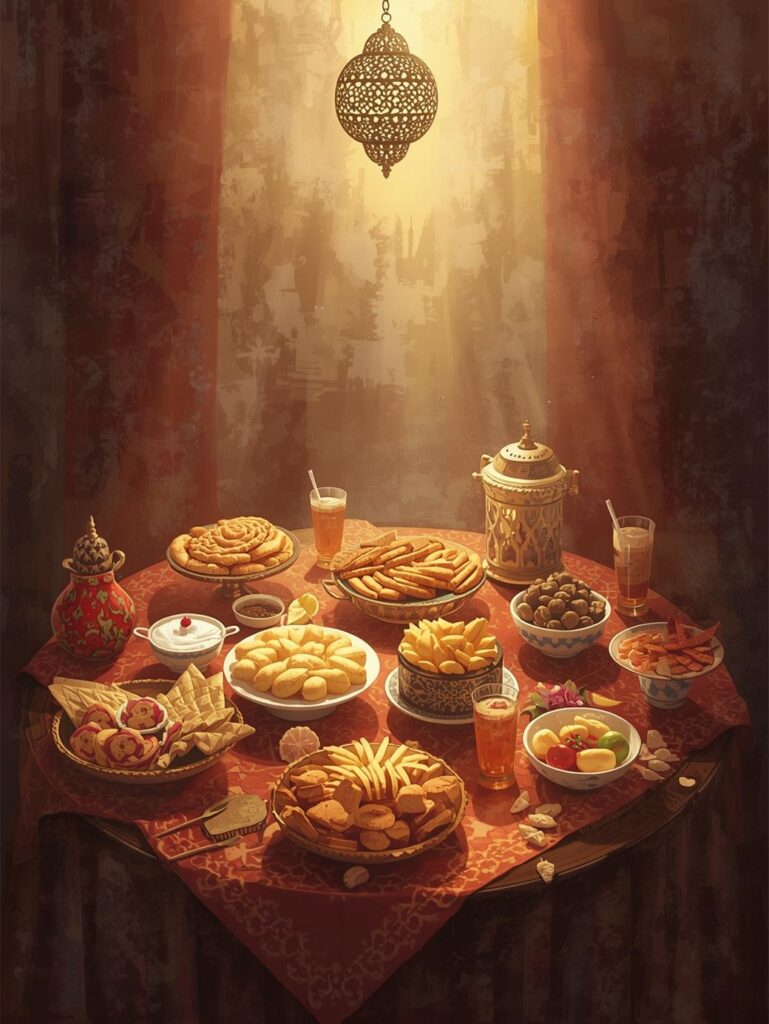
Dreaming of a feast in Islam — a joyful, generous atmosphere signals abundance and gratitude; chaos or excess signals a dunya warning
Quick Reference: Ramadan Dream Meanings in Islam
| Dream Scenario | Core Islamic Meaning | Spiritual Sign | Best Response |
|---|---|---|---|
| Seeing Ramadan in a dream | Divine mercy, call to tawbah, renewal | ✅ Very Positive | Make tawbah, increase worship |
| Fasting in a dream | Sincerity, discipline, spiritual restraint | ✅ Positive | Guard tongue, increase dhikr |
| Eating while fasting | Hunger, inner conflict, forgetfulness | ⚠️ Context-dependent | Fast is valid — renew niyyah |
| Doing iftar in a dream | Relief coming, du’a answered, completion | ✅ Very Positive | Make shukr, trust in Allah |
| Dreaming of a feast | Abundance (calm) or dunya warning (chaotic) | ⚠️ Context-dependent | Stay moderate, give sadaqah |
| Laylat al-Qadr imagery | Call to maximise the last ten nights | ✅ Very Positive | Increase qiyam, I’tikaf, du’a |
| Nightmares in Ramadan | No meaning — from stress, nafs, or Shaytan | 🔴 Ignore entirely | Sunnah protocol, do not share |
| Seeing the Prophet ﷺ | Most blessed dream possible — truly seen | ✅ Most Positive | Increase salawat, Sunnah study |
Islamic Ruling: Can Dreams Be Used as Guidance?
This is the most important question to answer correctly — and where many Muslims go wrong in both directions.
The practical test is simple: if the action a dream seems to be encouraging already aligns with Qur’an and Sunnah — take the motivation. If it contradicts established Islamic guidance — reject the dream, regardless of how vivid or peaceful it felt. Begin with the foundational guide: Three Types of Dreams in Islam — Complete Guide →
FAQs — People Also Ask About Ramadan Dreams
Summary
- ✓Dreams in Ramadan may feel more vivid due to fragmented sleep, fasting physiology, Qur’an before sleep, and heightened spiritual emotion — but vividness is not proof of divine origin
- ✓Islam’s three-category framework applies equally in Ramadan: ru’ya (true), hulm (nightmare), hadith an-nafs (self-talk)
- ✓Ramadan’s conditions — increased worship, reduced sin, purity, and remembrance — are precisely what classical scholars identified as conducive to receiving ru’ya
- ✓Eating while fasting in a dream is not sinful and does not break the fast — zero legal consequence
- ✓Iftar dreams signal relief, completion, and answered du’a; fasting dreams signal sincerity and self-discipline
- ✓Nightmares in Ramadan have no spiritual meaning — follow the Sunnah protocol and dismiss immediately
- ✓Dreams never override Qur’an or Sunnah — they may motivate, never legislate
Final Thoughts
Understanding dreams in Ramadan meaning in Islam requires the same quality that Ramadan itself cultivates: balance. The heart opened by fasting, night prayer, and Qur’an is more sensitive — and that sensitivity may bring clearer dreams. But Islam channels that sensitivity toward worship, not toward dream-obsession.
Take the gifts Ramadan brings in sleep. Let a comforting dream deepen your gratitude. Let a meaningful vision push you toward tawbah. Let an iftar dream remind you that patience has an end. But then return — as always — to the Qur’an, the Sunnah, and the act of worship itself. That is where Ramadan’s real gifts live.
If you dreamed something this Ramadan and want to understand what Islam says about it — don’t guess. Use a tool built on classical scholarship:
Sahih al-Bukhari 6983 — Verify on Sunnah.com ↗
✨ Personalised Free Dream Interpretation
Describe any dream from this Ramadan — seeing the Prophet ﷺ, eating while fasting, iftar, angels, a feast, or anything else. Get a scholar-grounded Islamic interpretation personalised to your dream in seconds. Built on Ibn Sirin, Imam al-Karmani, and authenticated Hadith.
📖 Continue Reading
📚 Sources & References
- Sahih al-Bukhari 1899; Sahih Muslim 1079 — Gates of Paradise opened, devils chained in Ramadan. Sunnah.com ↗
- Sahih Muslim 2263 — Prophetic hadith on the three types of dreams. Sunnah.com ↗
- Sahih al-Bukhari 6983 — “The true dream of a righteous man is one of forty-six parts of prophethood.” Sunnah.com ↗
- Sahih al-Bukhari 7044 — Prophetic guidance on handling nightmares. Sunnah.com ↗
- Sahih al-Bukhari 6994 — “Whoever sees me in a dream has truly seen me.” Sunnah.com ↗
- Sunan Ibn Majah 3906 — Classification of dream types. Sunnah.com ↗
- Ibn Sirin (d. 728 AH), Muntakhab al-Kalam fi Tafsir al-Ahlam — Classical framework for Islamic dream interpretation, conditions for ru’ya, dreamer’s spiritual state as interpretive lens
- Imam al-Nabulsi, Ta’tir al-Anam fi Tafsir al-Manam — Conditions for true dreams, spiritual purity and truthfulness as prerequisites
- Ibn Qutaybah, Ta’bir al-Ru’ya — On the role of Islamic knowledge in correct dream interpretation
Every Ramadan Dreams Dream Scenario Interpreted
✦ Positive
✦ Positive
✦ Positive
◆ Contextual
✦ Positive
What Three Classical Scholars Say About Ramadan Dreams Dreams
Critical Mistakes When Interpreting Ramadan Dreams Dreams
- ✗Assuming every Ramadan dream is a true divine dreamEven in Ramadan, self-generated dreams (Ḥadīth al-Nafs) occur. A dream about food during fasting, for example, is almost certainly the mind’s response to hunger — not a divine communication requiring interpretation.
- ✗Not acting on positive Ramadan dreamsA Ramadan dream calling you to increase worship, reconcile a relationship, or give sadaqah carries urgency. The barakah of Ramadan amplifies both the message and the reward for acting on it.
- ✗Sharing significant Ramadan dreams carelesslyThe prophetic guidance on sharing dreams with only trusted people applies with even greater force during Ramadan — the spiritual weight of true dreams increases their vulnerability to being ‘broken’ by negative interpretation.
- ✗Sleeping excessively to ‘collect’ more dreamsSome people sleep excessively in Ramadan hoping for more spiritual dreams. This contradicts the purpose of Ramadan — spiritual vigilance, not sleep maximisation — and is unlikely to produce genuine true dreams.
- ✗Treating a Ramadan nightmare as spiritually significantNightmares in Ramadan are treated the same way as at any other time — follow the Sunnah protocol (spit left three times, seek refuge, change position) and do not interpret them as divine messages.
🌙 Capture Your Ramadan Dreams
Ramadan dreams are among the most spiritually significant of the year. Document them nightly — you may be receiving guidance you don’t want to lose.
📚 Related Islamic Dream Guides
📚 Authoritative Islamic Sources Referenced
- Ibn Sirin, Muhammad. Tafsir al-Ahlam al-Kabir. Beirut: Dar al-Kutub al-Ilmiyyah.
- Al-Nabulsi, Abd al-Ghani. Ta’tir al-Anam fi Tafsir al-Ahlam. Cairo: Dar al-Hadith.
- Al-Bukhari, Muhammad. Sahih al-Bukhari, Kitab al-Ta’bir. View Hadith 6985 on Sunnah.com ↗
- Muslim ibn al-Hajjaj. Sahih Muslim, Kitab al-Ru’yā. View Hadith 5901 on Sunnah.com ↗
- Ibn Qutaybah, Abd Allah. Ta’bir al-Ru’yā. Beirut: Dar al-Kutub al-‘Ilmiyyah.
- Al-Qurtubi, Muhammad. Al-Tadhkirah fi Ahwal al-Mawta.
- Qur’an — multiple Surahs referenced in article. Read on Quran.com ↗