 The Dream Explainer
The short answer
Seeing the Prophet ﷺ in a dream has a unique place in Islam because authentic hadith say Shayṭān cannot appear in his true form. Scholars such as Ibn Sīrīn advised checking whether the figure matches the Prophet’s ﷺ transmitted physical description. If the form is unclear or unfamiliar, the dream may still be meaningful — but it should not be claimed with certainty as a confirmed sighting. Allah knows best.
In simple terms: Islam accepts that seeing the Prophet ﷺ in a dream can be real. But scholars advised caution: the dream should match his transmitted description. If the dream is unclear, treat it as meaningful reflection — not certain proof.
In this article
- The authentic hadith foundation
- Can Shayṭān appear as the Prophet ﷺ?
- Where this dream fits in the three types of dreams
- Ibn Sīrīn’s condition
- Physical description of the Prophet ﷺ
- Possible meanings
- Unclear or unfamiliar form
- What to do after the dream
- Common misconceptions
- Frequently asked questions
Seeing the Prophet ﷺ in a Dream: The Authentic Hadith
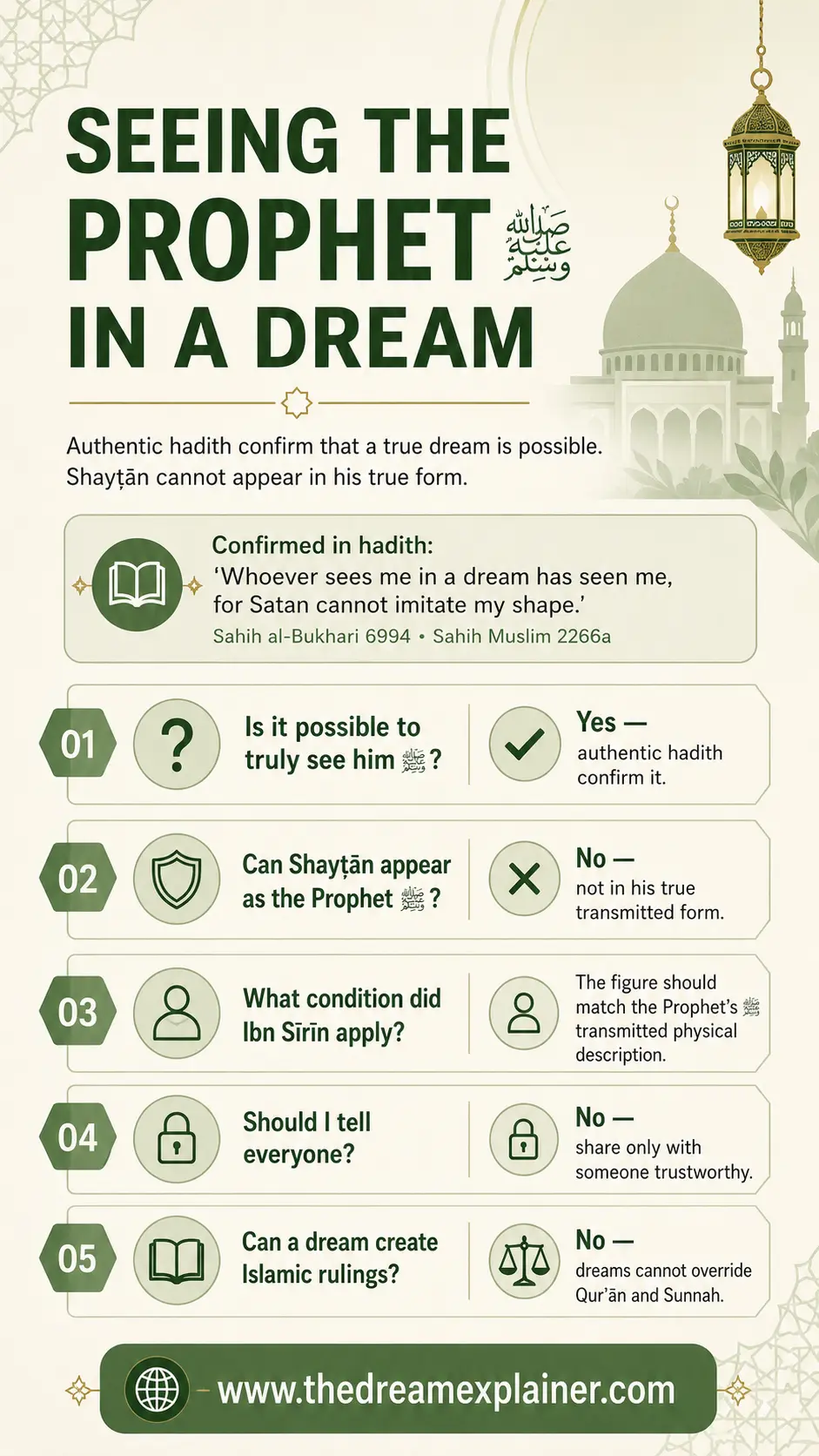
Every discussion of this topic begins with the authentic hadith. The Prophet ﷺ said:
مَنْ رَآنِي فِي الْمَنَامِ فَقَدْ رَآنِي، فَإِنَّ الشَّيْطَانَ لَا يَتَمَثَّلُ بِي
“Whoever sees me in a dream has truly seen me, for Shayṭān cannot take my form.”
Reported by Abū Hurayrah رضي الله عنه — Ṣaḥīḥ al-Bukhārī 6994
Another narration in the same chapter says:
مَنْ رَآنِي فِي الْمَنَامِ فَسَيَرَانِي فِي الْيَقَظَةِ، وَلَا يَتَمَثَّلُ الشَّيْطَانُ بِي
“Whoever sees me in a dream will see me while awake, and Shayṭān cannot take my form.”
Reported by Abū Hurayrah رضي الله عنه — Ṣaḥīḥ al-Bukhārī 6993
Classical scholars explained the phrase “will see me while awake” in more than one way. Ibn Ḥajar al-ʿAsqalānī رحمه الله mentioned that one strong interpretation is that the believer will see the Prophet ﷺ on the Day of Judgement.
The key point is clear: Allah ﷻ did not allow Shayṭān to take the Prophet’s ﷺ true form. This is why seeing the Prophet ﷺ in a dream is treated differently from ordinary dream symbols.
Can Shayṭān Appear as the Prophet ﷺ in a Dream?
No — Shayṭān cannot appear in the Prophet’s ﷺ true transmitted form. This is established by authentic hadith.
However, scholars still advised caution. A figure in a dream may claim to be the Prophet ﷺ, but the claim itself is not the proof. The important question is whether the figure matches the physical description transmitted from the Companions رضي الله عنهم.
Important: The hadith guarantee applies to the Prophet’s ﷺ true form. If the dream figure is distorted, frightening, unclear, or unfamiliar, it should not be claimed with certainty as a confirmed sighting.
Where This Dream Fits in the Three Types of Dreams
Before interpreting any dream, Islamic dream guidance begins with the three broad categories mentioned in authentic hadith: true dreams, disturbing dreams, and inner thoughts.
For the broader method, you can read our guide to Islamic dream interpretation in Islam.
1. Ru’yā — the true dream
A true dream is a glad tiding from Allah ﷻ. When the Prophet ﷺ appears in the form transmitted by the Companions, scholars placed this dream in the category of true dreams. True dreams are also described as part of prophethood in Ṣaḥīḥ al-Bukhārī 6989.
2. Ḥulm — the disturbing dream
A disturbing dream is from Shayṭān. Since Shayṭān cannot appear in the Prophet’s ﷺ true form, a frightening or distorted dream should not be treated as a confirmed sighting. If a dream causes fear, follow the Sunnah guidance in what to do after a bad dream in Islam.
3. Ḥadīth al-Nafs — inner thoughts
Some dreams come from a person’s thoughts, emotions, or daily focus. A Muslim who thinks often about the Prophet ﷺ, reads his biography, or listens to talks about him may dream of him without that dream necessarily being a confirmed Ru’yā.
The three-part framework is based on authentic narrations, including Ṣaḥīḥ Muslim 2263a and Ṣaḥīḥ al-Bukhārī 6986.
Ibn Sīrīn’s Condition for Confirming the Dream
Muḥammad ibn Sīrīn رحمه الله was one of the most respected early authorities connected to Islamic dream interpretation. A report cited by Ibn Ḥajar in Fatḥ al-Bārī shows that he did not accept every claim of seeing the Prophet ﷺ without checking the description.
If a man told Ibn Sīrīn that he had seen the Prophet ﷺ in a dream, he would say: “Describe to me the one whom you saw.” If the person gave a description he did not recognise, he would say: “You did not see him.”
Cited by Ibn Ḥajar al-ʿAsqalānī in Fatḥ al-Bārī, Kitāb al-Taʿbīr, 12/383–384
Another report mentions Ibn ʿAbbās رضي الله عنه asking a person to describe what he saw. When the description resembled al-Ḥasan ibn ʿAlī رضي الله عنه — who was known to resemble the Prophet ﷺ — Ibn ʿAbbās accepted the dream.
This shows the careful method of early scholars. They did not rely only on a dream figure saying, “I am the Prophet.” They asked whether the figure matched the transmitted description.
Balanced rule: If the description matched the transmitted descriptions, early scholars such as Ibn Sīrīn were more willing to treat the dream as a true sighting. If it did not match, they avoided confirming it.
Physical Description of the Prophet ﷺ in Dreams
The books of al-Shamāʾil preserve descriptions of the Prophet ﷺ from the Companions who saw him directly. These descriptions are important because Ibn Sīrīn’s method depended on recognising the form.
- He was of medium to slightly above-medium height — neither notably short nor excessively tall.
- His face was described as luminous and beautiful, shining like the full moon.
- His complexion was fair with a slight reddish tone.
- He had large, dark eyes and naturally kohl-like lashes.
- His hair was neither completely straight nor tightly curled.
- His beard was full and balanced.
- The number of white hairs in his hair and beard was small and did not exceed twenty according to narrations cited by scholars.
- The Seal of Prophethood was between his shoulder blades.
These descriptions are not included so people become harsh with themselves. They are included because early scholars used them to separate confirmed sighting from unclear spiritual dreams.
Many Muslims sincerely love the Prophet ﷺ and deeply wish to see him. That love is honourable. But emotional intensity alone is not verification. A dream may be meaningful and spiritually moving without being a confirmed sighting of the Prophet ﷺ.
What Seeing the Prophet ﷺ in a Dream May Mean
When the description matches and the dream carries the clarity of a true dream, classical scholars often understood it as a positive sign. Still, the meaning depends on the dreamer’s condition, the details of the dream, and Allah’s knowledge.
Important limitation: The meanings below are classical interpretive possibilities, not guaranteed outcomes and not Islamic rulings. They should be used for reflection, not certainty.
Relief from difficulty
For someone in hardship, debt, sadness, or distress, this dream may be a sign of hope and mercy. It should lead the person to gratitude, patience, and renewed trust in Allah ﷻ.
A call to follow the Sunnah
Seeing the Prophet ﷺ may be a reminder to return to his teachings, improve worship, leave sins, and revive neglected Sunnah practices.
Glad tidings
A peaceful and clear dream, especially one in which the Prophet ﷺ appears pleased or smiling, may be understood as a glad tiding. Allah knows best.
A reminder of spiritual responsibility
The dream should not create pride. It should make the dreamer more humble, more careful with salah, more sincere, and more attached to the Qurʾān and Sunnah.
Context-specific meanings mentioned in classical dream books
Some classical books of dream interpretation, including works attributed to Ibn Sīrīn and al-Nābulusī’s Taʿṭīr al-Anām fī Taʿbīr al-Manām, mention more specific possibilities. These should be read as reflective material, not as binding religious judgements.
- Eating with the Prophet ﷺ was interpreted by some scholars as a reminder to fulfil the obligations of zakāt.
- Shaking the Prophet’s ﷺ hand was read as a sign of sincere following of the Sunnah.
- Seeing him barefoot was interpreted in some texts as a warning about neglecting regular salah.
- Seeing him walking behind a funeral was linked by some scholars to concern about religious innovation in the community.
- A grave or displeased expression was treated as a serious call to examine one’s behaviour and return to correct practice.
A dream — even a confirmed sighting — does not create a new religious obligation, does not cancel an established ruling, and cannot be used to justify anything that contradicts the Qurʾān and Sunnah.
If the Prophet ﷺ Appeared in an Unclear or Unfamiliar Form
Many people report dreams in which they believe they saw the Prophet ﷺ but cannot clearly remember the description. Some may see a noble figure, hear a name, or feel a strong spiritual emotion.
In this case, the safest approach is balanced: do not deny that the dream may be meaningful, but do not claim certainty that it was a confirmed sighting.
Some scholars noted that an altered or symbolic form may still carry spiritual meaning. It may reflect the dreamer’s relationship with the Sunnah, their emotional state, or their need to return to Allah ﷻ.
Safe wording: “I had a dream that reminded me of the Prophet ﷺ” is safer than saying, “I definitely saw the Prophet ﷺ,” when the description is unclear.
Hold the experience with gratitude. Make duʿā. Send ṣalawāt. Reflect on your practice. But avoid making claims beyond what you know.
What to Do After Seeing the Prophet ﷺ in a Dream
If the dream was peaceful and appears to meet the conditions of a true dream, receive it with humility and gratitude.
1. Praise Allah ﷻ
Say Alḥamdulillāh. A good dream is a blessing and should first be met with gratitude.
2. Send ṣalawāt upon the Prophet ﷺ
Allah ﷻ commands the believers to send blessings upon the Prophet ﷺ in Surah Al-Aḥzāb 33:56.
3. Reflect on your spiritual state
Ask yourself: Am I guarding salah? Am I following the Sunnah? Is there something I need to correct?
4. Share it only with someone trustworthy
A good dream should not be used for pride, attention, or public status. Share it only with someone wise, loving, and trustworthy.
5. Do not build rulings on it
If something in the dream agrees with Qurʾān and Sunnah, take it as encouragement. If it appears to contradict Islamic law, do not act on it.
If the dream came after istikhārah, it may feel personally meaningful, but it still does not replace consultation, reason, and lawful decision-making. You can read more in our guide to a dream after istikhārah.
For spiritual preparation before sleep, see how to have good dreams in Islam and duʿā before sleeping in Islam.
Common Misconceptions
“Seeing the Prophet ﷺ means I am spiritually superior.”
No. The correct response is humility, gratitude, and renewed obedience. Treating the dream as a badge of superiority is spiritually dangerous.
“Anyone who says ‘I am the Prophet’ in a dream must be him.”
No. Ibn Sīrīn’s method shows that description matters. A verbal claim inside a dream is not enough.
“If the Prophet ﷺ told me something in a dream, I must follow it.”
If it agrees with Qurʾān and Sunnah, it may be taken as a reminder. If it contradicts established Islamic law, it must not be followed.
“Seeing the Prophet ﷺ means all my sins are forgiven.”
No reliable mainstream position makes this broad claim. The dream is a sign of hope and mercy, not a guarantee that removes accountability.
Read Next in This Cluster
Frequently Asked Questions
Is seeing the Prophet ﷺ in a dream always a true dream?
It may be a true dream if the figure matches the Prophet’s ﷺ transmitted description. If the form is unclear, unfamiliar, distorted, or frightening, scholars advised caution and did not recommend claiming certainty.
Can Shayṭān appear as the Prophet ﷺ?
Authentic hadith state that Shayṭān cannot take the Prophet’s ﷺ true form. However, a dream figure may claim something, so scholars checked whether the form matched the transmitted description.
What if I cannot remember the Prophet’s ﷺ description clearly?
Treat the dream with gratitude and humility, but do not claim certainty. It is safer to say that the dream reminded you of the Prophet ﷺ rather than saying you definitely saw him.
I saw someone who told me they were the Prophet ﷺ, but I felt afraid. What does this mean?
A frightening or confusing dream should be approached carefully. Since Shayṭān cannot appear in the Prophet’s ﷺ true form, the description and feeling of the dream should be examined. Do not claim certainty if the form was unclear or distressing.
Does seeing the Prophet ﷺ after istikhārah carry special meaning?
It may feel meaningful, especially if the dream is calm and clear. But it still does not replace consultation, practical judgement, and Islamic guidance. Dreams after istikhārah should be treated with balance.
Can a dream of the Prophet ﷺ create Islamic rulings?
No. Dreams cannot create new obligations, cancel existing rulings, or override the Qurʾān, authentic Sunnah, and established Islamic law.
How can I increase the likelihood of seeing the Prophet ﷺ in a dream?
There is no guaranteed method. But a Muslim can increase love for the Prophet ﷺ, follow the Sunnah, guard salah, avoid sins, sleep with purity when possible, recite bedtime adhkār, and send ṣalawāt often.
Is it permissible to tell others I saw the Prophet ﷺ in a dream?
A good dream may be shared with someone trustworthy, wise, and loving. It should not be broadcast publicly for pride, attention, or status.
Source note
Classical dream interpretation texts — including works attributed to Ibn Sīrīn and al-Nābulusī — include reports with varying levels of transmission and scholarly acceptance. This article treats them as reflective scholarly material, not binding religious rulings. Authentic hadith and Qurʾānic evidence are given priority throughout.
Disclaimer: This article offers Islamic educational reflection based on Qurʾān, authentic hadith, and classical scholarship. It is not a fatwa. For personal religious rulings, ask a qualified scholar. Allah knows best.
References and Sources
- Al-Bukhārī, Muḥammad ibn Ismāʿīl. Ṣaḥīḥ al-Bukhārī, Kitāb al-Taʿbīr. Hadith 6993 and 6994.
- Muslim ibn al-Ḥajjāj. Ṣaḥīḥ Muslim, Kitāb al-Ru’yā. Hadith 2263a and related narrations.
- Ibn Ḥajar al-ʿAsqalānī, Aḥmad ibn ʿAlī. Fatḥ al-Bārī Sharḥ Ṣaḥīḥ al-Bukhārī, Kitāb al-Taʿbīr, vol. 12, pp. 383–384.
- Works attributed to Ibn Sīrīn, including Muntakhab al-Kalām fī Tafsīr al-Aḥlām, treated here as reflective material with caution.
- Al-Nābulusī, ʿAbd al-Ghanī. Taʿṭīr al-Anām fī Taʿbīr al-Manām.
- Al-Tirmidhī, Muḥammad ibn ʿĪsā. Al-Shamāʾil al-Muḥammadiyyah.
- Qurʾān — Surah Al-Aḥzāb 33:56.