 The Dream Explainer
Quick Answer
The simplest dua before sleeping in Islam is:
بِاسْمِكَ اللَّهُمَّ أَمُوتُ وَأَحْيَا
Bismika Allahumma amutu wa ahya
“In Your name, O Allah, I die and I live.” This authentic bedtime dua is reported in Sahih al-Bukhari and Sahih Muslim. The wider Sunnah bedtime routine also includes wudu, sleeping on the right side, Ayat al-Kursi, the three Quls, and other protective adhkar.
Why sleep is an act of worship in Islam
Dua before sleeping in Islam is more than a bedtime habit. It is an act of worship, trust, and surrender to Allah.
The Qur’an describes sleep as one of Allah’s signs:
“And of His signs is your sleep by night and by day, and your seeking of His bounty. Indeed in that are signs for a people who listen.”
“Allah takes the souls at the time of their death, and those that have not died during their sleep…”
This is why Muslim scholars often describe sleep as a kind of minor death. Each night, the believer entrusts the soul to Allah. Each morning, waking becomes a mercy and a return.
For this reason, the Prophet Muhammad ﷺ taught Muslims to end the day with remembrance, purification, Qur’anic recitation, and trust in Allah.
If you want the broader Islamic framework for dreams, see our complete guide to Islamic dream interpretation.
Complete Sunnah bedtime routine
The Sunnah bedtime routine does not have to feel heavy. Start with what you can do consistently, then build slowly.
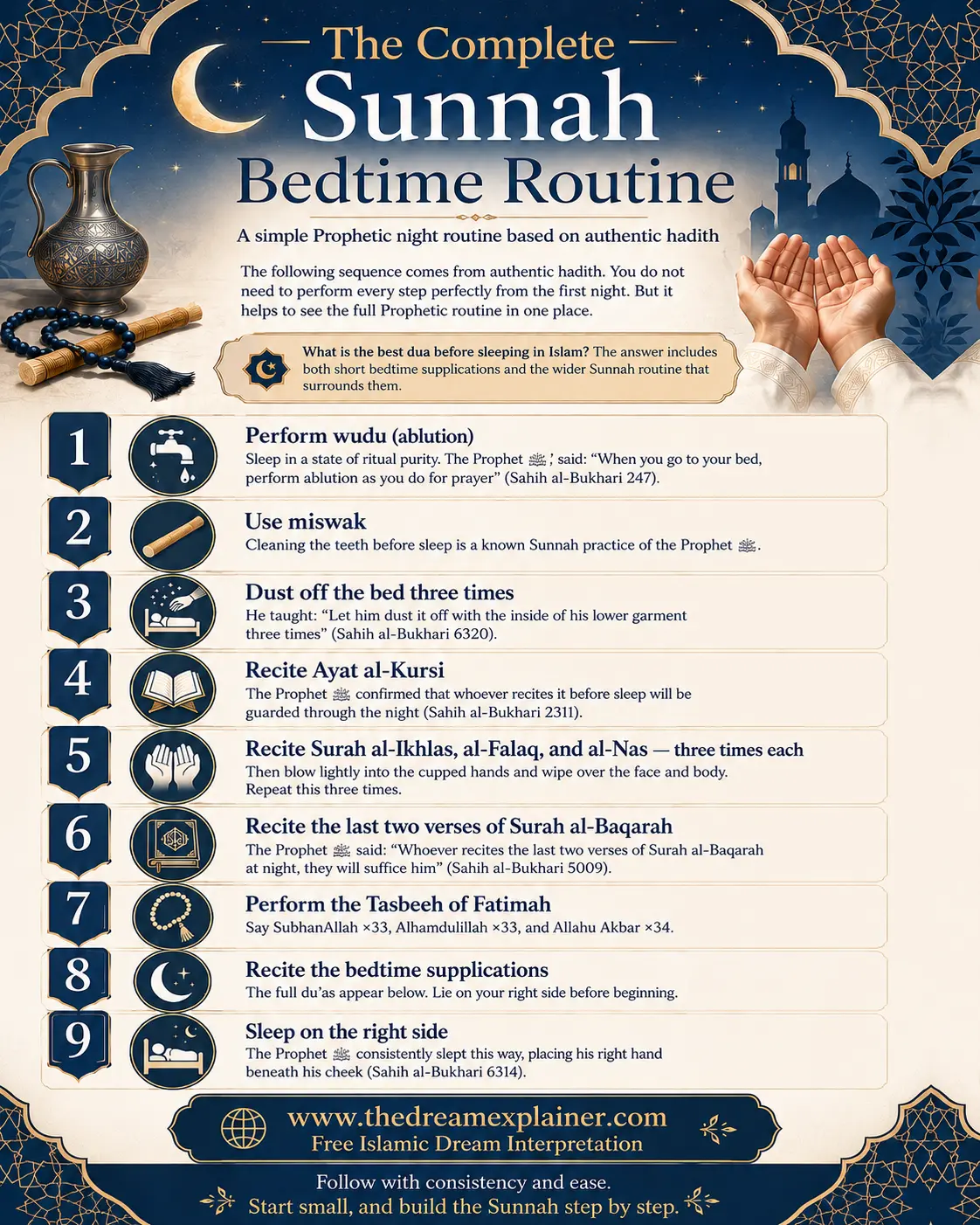
If you are very tired, start with this short routine:
- Make wudu if possible
- Recite Ayat al-Kursi
- Recite Surah al-Ikhlas, al-Falaq, and al-Nas
- Say the short bedtime dua
- Sleep on your right side
Perform wudu
The Prophet ﷺ said: “Whenever you go to bed, perform ablution like that for the prayer.”
Lie on your right side
The same narration teaches lying on the right side before saying the bedtime supplication.
Dust off the bed
The Prophet ﷺ taught that a person should dust off the bed before lying down.
Recite Ayat al-Kursi
Ayat al-Kursi is strongly connected with protection through the night.
Recite the three Quls
Recite Surah al-Ikhlas, al-Falaq, and al-Nas, blow lightly into your hands, then wipe over the body.
Recite the last two verses of al-Baqarah
The Prophet ﷺ said whoever recites the last two verses of Surah al-Baqarah at night, they will suffice him.
Say the Tasbeeh of Fatimah
Say SubhanAllah 33 times, Alhamdulillah 33 times, and Allahu Akbar 34 times before sleep.
End with the bedtime duas
Try to make the final words before sleep words of faith, surrender, and remembrance of Allah.
Dua before sleeping in Islam: core Sunnah supplications
These are the main bedtime duas every Muslim should try to learn. You do not need to memorize all of them at once. Begin with the short dua, then add more with time.
1. The simplest dua before sleeping
بِاسْمِكَ اللَّهُمَّ أَمُوتُ وَأَحْيَا
Bismika Allahumma amutu wa ahya
“In Your name, O Allah, I die and I live.”
This short dua carries the heart of the whole bedtime routine. Life and death are in Allah’s hands, and the believer sleeps in His name.
2. The comprehensive dua of surrender
اللَّهُمَّ أَسْلَمْتُ نَفْسِي إِلَيْكَ، وَفَوَّضْتُ أَمْرِي إِلَيْكَ، وَوَجَّهْتُ وَجْهِي إِلَيْكَ، وَأَلْجَأْتُ ظَهْرِي إِلَيْكَ، رَغْبَةً وَرَهْبَةً إِلَيْكَ، لَا مَلْجَأَ وَلَا مَنْجَا مِنْكَ إِلَّا إِلَيْكَ، آمَنْتُ بِكِتَابِكَ الَّذِي أَنْزَلْتَ وَبِنَبِيِّكَ الَّذِي أَرْسَلْتَ
Allahumma aslamtu nafsi ilayk, wa fawwadtu amri ilayk, wa wajjahtu wajhi ilayk, wa alja’tu zahri ilayk, raghbatan wa rahbatan ilayk. La malja’a wa la manja minka illa ilayk. Amantu bikitabika alladhi anzalta wa nabiyyika alladhi arsalt.
“O Allah, I submit myself to You, I entrust my affairs to You, I turn my face toward You, and I place my back in Your protection, out of hope and fear of You. There is no refuge and no escape from You except to You. I believe in Your Book which You revealed and Your Prophet whom You sent.”
The Prophet ﷺ taught this dua as part of the bedtime routine and instructed that it be among the final words before sleep.
It gathers faith, surrender, trust, hope, fear, and reliance upon Allah in one supplication.
3. Dua for protection from punishment
اللَّهُمَّ قِنِي عَذَابَكَ يَوْمَ تَبْعَثُ عِبَادَكَ
Allahumma qini ‘adhabaka yawma tab‘athu ‘ibadak
“O Allah, protect me from Your punishment on the Day You resurrect Your servants.”
This dua is reported in connection with the Prophet’s bedtime practice. It reminds the believer that sleep, waking, death, and resurrection all belong to Allah.
4. Dua for one who struggles to sleep
اللَّهُمَّ غَارَتِ النُّجُومُ، وَهَدَأَتِ الْعُيُونُ، وَأَنْتَ حَيٌّ قَيُّومٌ، لَا تَأْخُذُكَ سِنَةٌ وَلَا نَوْمٌ، يَا حَيُّ يَا قَيُّومُ، أَهْدِئْ لَيْلِي وَأَنِمْ عَيْنِي
Allahumma gharat al-nujum, wa hada’at al-‘uyun, wa anta Hayyun Qayyum. La ta’khudhuka sinatun wa la nawm. Ya Hayyu ya Qayyum, ahdi’ layli wa anim ‘ayni.
“O Allah, the stars have set, the eyes have grown still, and You are the Ever-Living, the Self-Sustaining. Neither slumber nor sleep overtakes You. O Ever-Living, O Self-Sustaining, calm my night and bring sleep to my eyes.”
— Reported in works of daily adhkar and commonly mentioned for one struggling to sleep
This supplication is often cited for sleeplessness. Since it is not as central as the strongest bedtime narrations above, it is best presented as a helpful reported dua rather than the main bedtime Sunnah.
Quranic recitations before sleep
Ayat al-Kursi
Ayat al-Kursi is one of the most important recitations before sleep.
In Sahih al-Bukhari, the Prophet ﷺ confirmed that whoever recites Ayat al-Kursi before sleeping will have protection from Allah through the night. Sahih al-Bukhari 2311
Recite it once before sleep with attention and trust in Allah.
Surah al-Ikhlas, al-Falaq, and al-Nas
The Prophet ﷺ would recite Surah al-Ikhlas, Surah al-Falaq, and Surah al-Nas before sleep, blow into his hands, and wipe over his body. He would do this three times.
These three surahs bring together tawhid, seeking refuge from outward harm, and seeking refuge from hidden whispering.
The last two verses of Surah al-Baqarah
“Whoever recites the last two verses of Surah al-Baqarah at night, they will suffice him.”
Scholars explained “they will suffice him” in more than one way, including sufficiency in protection, worship, and spiritual reassurance. Allah knows best.
Surah al-Kafirun
Surah al-Kafirun is also reported as a recitation before sleep because it declares freedom from shirk.
“Recite Qul ya ayyuhal-kafirun before you sleep, for it is a disavowal of shirk.”
Tasbeeh of Fatimah before sleep
The Prophet ﷺ taught Fatimah رضي الله عنها a dhikr before sleep that is simple and powerful.
When you go to bed, say SubhanAllah thirty-three times, Alhamdulillah thirty-three times, and Allahu Akbar thirty-four times.
SubhanAllah
× 33
Alhamdulillah
× 33
Allahu Akbar
× 34
This dhikr brings the heart back to Allah at the end of the day. It is especially meaningful for anyone who feels tired, burdened, or mentally restless before sleep.
Dua upon waking
The Sunnah of sleep continues when the eyes open.
الْحَمْدُ لِلَّهِ الَّذِي أَحْيَانَا بَعْدَ مَا أَمَاتَنَا وَإِلَيْهِ النُّشُورُ
Alhamdu lillahi alladhi ahyana ba‘da ma amatana wa ilayhi al-nushur
“All praise is to Allah, who gave us life after causing us to die, and to Him is the resurrection.”
This dua reminds the believer that waking is a mercy. Allah returned the soul and gave another day to worship Him.
What to do after a bad dream
If you see a disturbing dream, Islam gives a calm and practical response.
If a person sees a dream they dislike, they should spit lightly to the left three times, seek refuge with Allah from Shaytan, and turn to the other side.
After a bad dream:
- Spit lightly to the left three times
- Seek refuge in Allah from Shaytan
- Turn to the other side
- Do not share the dream carelessly
- Do not build fear or certainty on it
A bad dream should not be treated as a guaranteed sign. It may simply be from Shaytan, stress, fear, or ordinary mental activity. Allah knows best.
For more detail, read our full guide to what to do after a bad dream in Islam.
Does the bedtime routine affect dreams?
The bedtime routine may help the heart enter sleep with remembrance, protection, and calm. However, it should not be treated as a guaranteed way to force good dreams.
In Islam, true dreams are from Allah, bad dreams are from Shaytan, and many dreams may come from thoughts, worries, or daily experiences.
Good sleep habits, halal living, truthful speech, wudu, Qur’an, and adhkar may all support a calmer spiritual state before sleep. But interpretation still requires caution, humility, and the phrase: Allah knows best.
For more guidance, see our article on how to have good dreams in Islam.
Sleep paralysis in Islam
Sleep paralysis can feel frightening. A person may wake but feel unable to move, sometimes with pressure, fear, or a sense of presence.
Islamically, a person should seek refuge in Allah, strengthen bedtime adhkar, and avoid panic. From a medical angle, sleep paralysis is also linked with stress, sleep deprivation, and irregular sleep patterns.
These two approaches do not conflict. A Muslim can use spiritual protection while also improving sleep routine and seeking professional help if episodes are frequent or severe.
- Sleep in wudu when possible
- Recite Ayat al-Kursi and the three Quls before sleep
- Avoid frightening or spiritually harmful content before bed
- Improve sleep timing and reduce exhaustion
- Speak to a qualified scholar or doctor if needed
For a dedicated explanation, read our full guide to sleep paralysis in Islam.
Frequently asked questions
What is the simplest dua before sleeping in Islam?
The simplest dua before sleeping in Islam is: Bismika Allahumma amutu wa ahya, meaning, “In Your name, O Allah, I die and I live.” It is short, authentic, and easy to memorize.
What is the most important dua before sleeping?
The comprehensive dua of surrender has a very high place because the Prophet ﷺ taught it with wudu and sleeping on the right side. If you are starting slowly, combine it with Ayat al-Kursi and the three Quls.
What should I recite before sleep for protection?
Recite Ayat al-Kursi, Surah al-Ikhlas, Surah al-Falaq, and Surah al-Nas. The last two verses of Surah al-Baqarah are also strongly recommended at night.
What if I fall asleep before finishing the adhkar?
Do what you can consistently. Start with the shortest bedtime dua, Ayat al-Kursi, and the three Quls. Over time, the routine usually becomes easier.
What should I do after a bad dream?
Spit lightly to the left three times, seek refuge in Allah from Shaytan, turn to the other side, and do not share or interpret the dream carelessly.
Is there a special Istikhara dua before sleeping?
No separate bedtime dua is established specifically for after Istikhara. Pray Istikhara properly, say the known Istikhara dua, and then continue with the normal bedtime adhkar. A dream is not required for Istikhara to be valid.
Can children learn bedtime duas?
Yes. Children can begin with the shortest dua, the three Quls, and Ayat al-Kursi. Keep it gentle and gradual so the routine feels loved, not forced.
Keep your bedtime adhkar, dream notes, and personal reflections in one private place. Our Islamic Dream Journal includes guided prompts for recording dreams with care, humility, and the reminder that Allah knows best.